
If you were to take a decently long countryside walk in summer near where I live, you’d almost certainly pass a hundred or more wild foxgloves. To (nearly) quote blogging buddy, Maureen, they’re the ones ‘that planted their own selves’. And to my eye they’re the better for it.
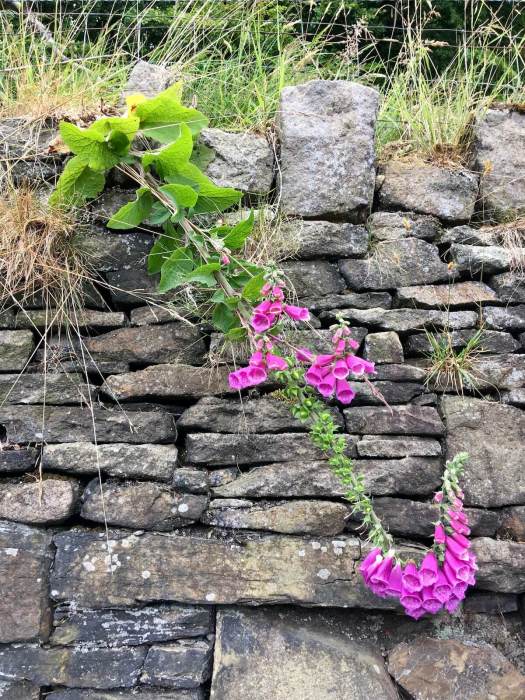
Their habit of tumbling down banks and walls, swinging out on the wind towards passers-by who come too close, gave rise to folklore’s claim that foxgloves nod in deference when a member of the gentry passes by.
Most likely they do, but I can vouch that they also nod to commoners (unless foxgloves know more about my ancestry than do I).

Foxgloves mingle beautifully in flower borders, but it always surprises me to see them used as bedding plants, especially when they are evenly spaced in straight rows.
Not that they’re likely to remain regular – even the sturdiest, most upright ones have a habit of straying.
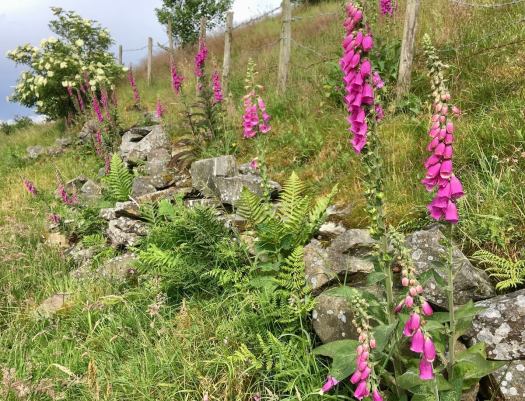
Deep pink Digitalis purpurea, plus a smattering of white ones and a rarer pale pink form, are the ones we have in Lancashire.
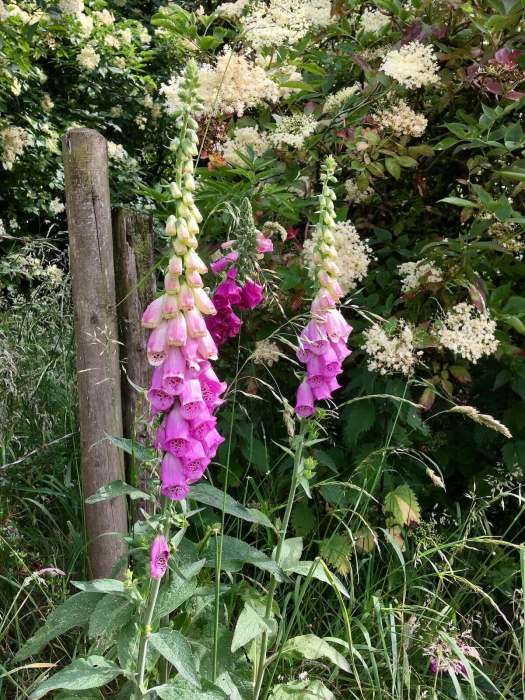
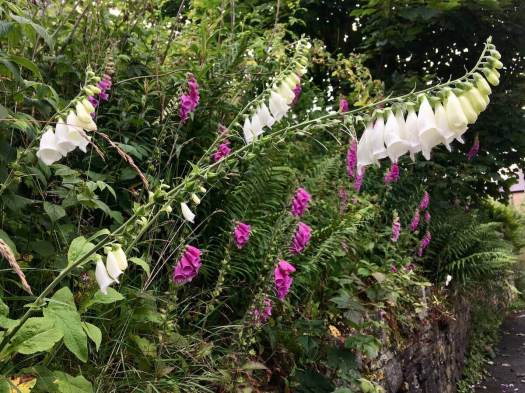
White foxgloves have an other quality, especially when they gleam in half-light. It’s easy to see how the folk name, Fairy’s petticoats, came about.
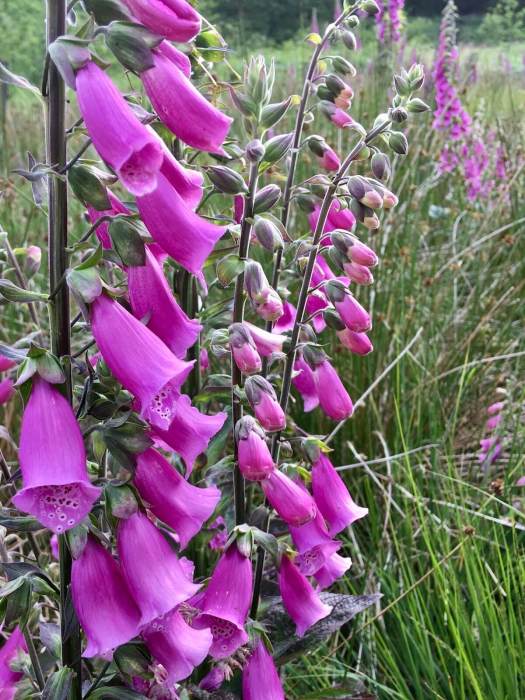
As not everyone has the chance to see foxgloves growing in their own style, I thought I’d share a few pictures that celebrate their wildness.
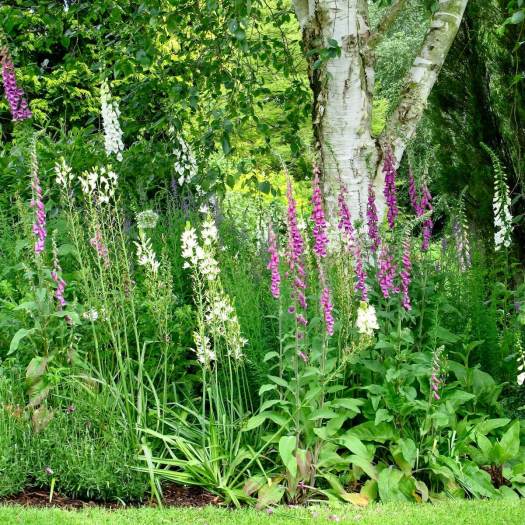
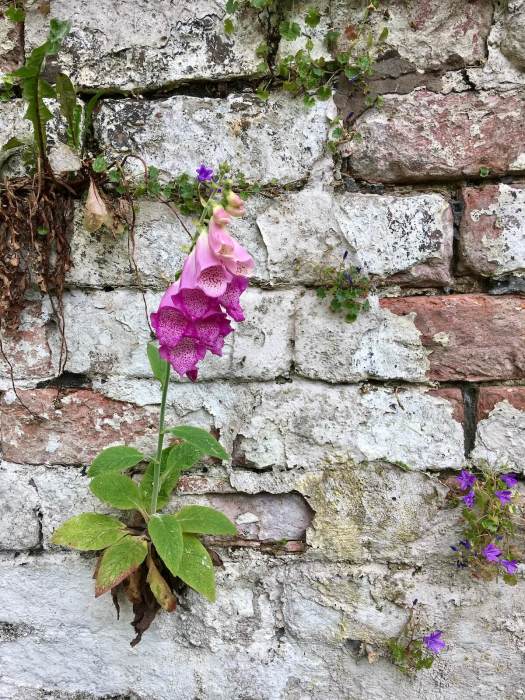
I’ll leave you with two images that show how the wild style can work in gardens, including a foxglove that had beautifully self-seeded with ferns and campanulas in the walled garden of a terraced house that opened for the National Garden Scheme in Liverpool earlier this year.
By this point in the year, their flower spikes are studded with seedpods that have turned brown and papery: effectively sprinklers that loose their tiny seeds wherever they sway.
Shared for Cee’s Flower of the Day.
 Susan Rushton
Thanks for sharing these with us. I have always been amazed when I have seen foxglove growing naturally along the road in GB. Here in Michigan they are almost considered an annual – they don’t live very long and mine didn’t seem to want to reseed themselves.
Our wild ones are biennials, although there are some cultivated perennial types, they tend not to last long.
Lovely photos, as always! I adore foxgloves and usually have white ones in my garden although they don’t seem to reseed themselves and I end up planting new ones.
They must reseed here, or at least they are always to be found where I expect them. They don’t seem to move or spread much. I wonder how far the white ones revert to pink ones when they seed? Roses tend to go back to pink.
Incredible how nature do it´s own thing… and you are lucky you lived nearby. Lovely, they are quite rare over here.
They seem quite unfussy about conditions here and definitely like our old dry stone walls.
I can remember seeing these only once, in a garden bed in Arkansas. I wasn’t particularly fond of them when I saw them, but these are much more appealing. They remind me of our fall obedient plant (Physostegia virginiana)which spreads in the same way — often along roadsides.
Often the garden plants I’ve seen in the US have very sturdy flower spikes, so don’t have the grace of the wild ones, to my eye at least. The sturdy ones seem to blow down more easily too.
A fine tribute to a lovely flower that has been ubiquitous around here this year. Fairies’ Petticoats is a new one for me.
The Englishman’s Flora lists almost a page full of old names. Bee-catchers is another one, and Long Purples. I like Flowster-docken too (showy dock), and Snoxum because it makes me smile. It’s lovely that in the past ordinary people were on acquaintance terms with countryside flowers, so could name them creatively and aptly.
🙂
Lovely photographs! Foxgloves self-seed around our garden too, usually the pinks ones but we did have a couple that were a very pale yellow (not white). I hope they come back sometime!
I’d have liked to have seen the pale yellow ones.
They were very pretty – I did sprinkle some of their seeds around, so maybe I’ll get a few more in future.
They grow wild around here too, including my garden! I have never planted any but usually have one or more popping up each year – only the common pinky-purple ones though. I would love some white ones!
Are they part of the ingredients on the plant-covered walls locally that you have written about?
In the lanes, on the Cornish hedges, on the hill. They are everywhere!
Absolutely gorgeous!
Thanks, Lisa.
I’ve always liked foxgloves, especially the deep pink ones, and I love that self-seeded one growing in the wall 🙂
It looks perfectly designed to be perched on high. A pretty freckled pink too.
You’ve shown that digitalis also plants itself well in digital photographs.
My favourite wild plant!! I was overjoyed a few years ago when a large cluster of them suddenly started growing on our bank or earth that separates us from the field next door. This year they had spread much further!! 🙂
Beautiful. So glad you shared them.