
If you were to take a decently long countryside walk in summer near where I live, you’d almost certainly pass a hundred or more wild foxgloves. To (nearly) quote blogging buddy, Maureen, they’re the ones ‘that planted their own selves’. And to my eye they’re the better for it.
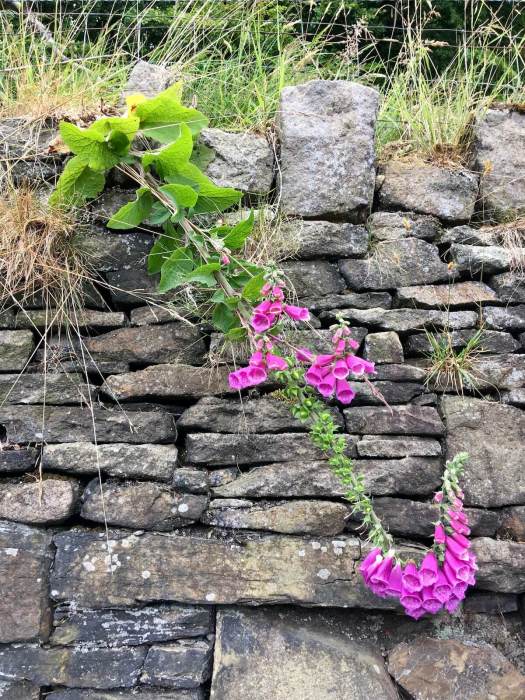
Their habit of tumbling down banks and walls, swinging out on the wind towards passers-by who come too close, gave rise to folklore’s claim that foxgloves nod in deference when a member of the gentry passes by.
Most likely they do, but I can vouch that they also nod to commoners (unless foxgloves know more about my ancestry than do I).

Foxgloves mingle beautifully in flower borders, but it always surprises me to see them used as bedding plants, especially when they are evenly spaced in straight rows.
Not that they’re likely to remain regular – even the sturdiest, most upright ones have a habit of straying.
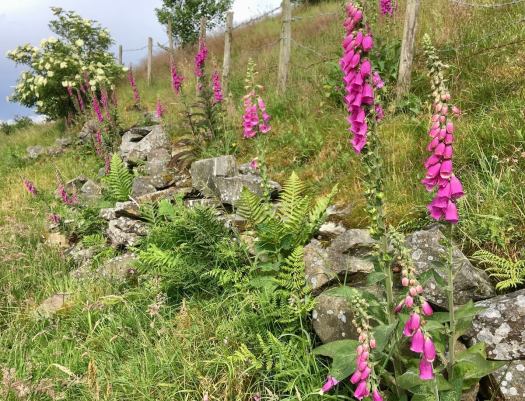
Deep pink Digitalis purpurea, plus a smattering of white ones and a rarer pale pink form, are the ones we have in Lancashire.
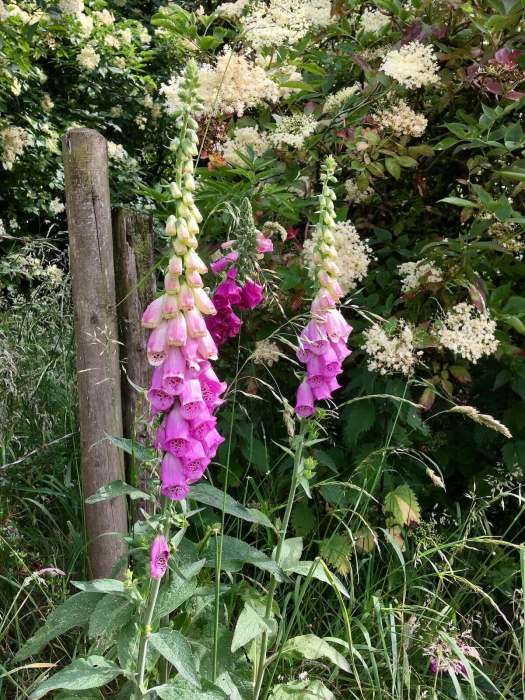
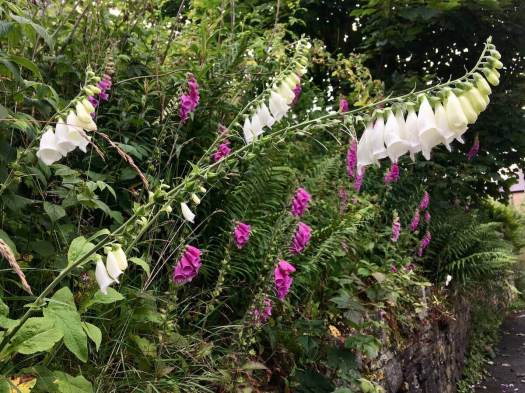
White foxgloves have an other quality, especially when they gleam in half-light. It’s easy to see how the folk name, Fairy’s petticoats, came about.
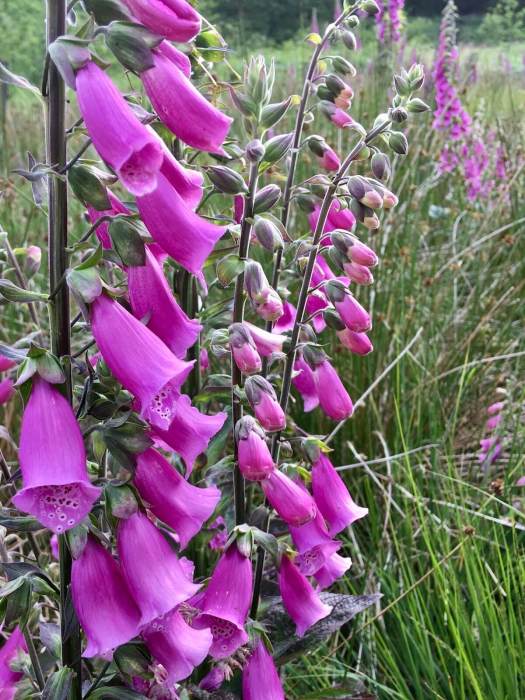
As not everyone has the chance to see foxgloves growing in their own style, I thought I’d share a few pictures that celebrate their wildness.
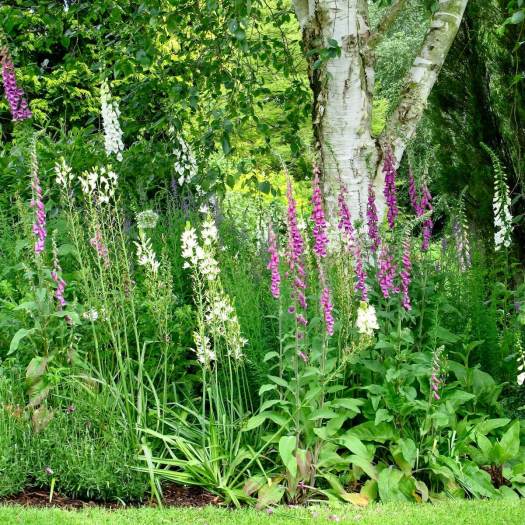
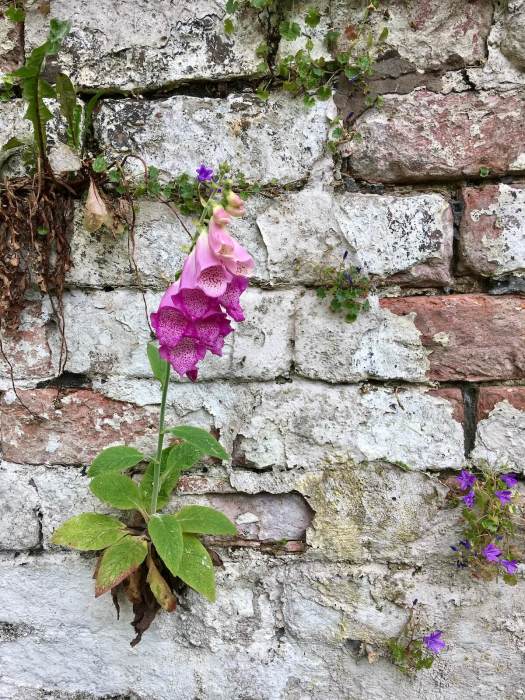
I’ll leave you with two images that show how the wild style can work in gardens, including a foxglove that had beautifully self-seeded with ferns and campanulas in the walled garden of a terraced house that opened for the National Garden Scheme in Liverpool earlier this year.
By this point in the year, their flower spikes are studded with seedpods that have turned brown and papery: effectively sprinklers that loose their tiny seeds wherever they sway.
Shared for Cee’s Flower of the Day.
 Susan Rushton
We don’t see them in the wild as much. I’ve grown them in the garden and the best thing is that deer don’t eat them.
The deer know what’s good for them – all parts are poisonous, to humans, at least.
Foxgloves planting their own selves! They do quite an admirable job of it too. I love the thought that maybe they know more about your ancestry than you do and are bowing therefore and thereat. Fairy’s petticoat is a wonderful name. I covet the white ones. And I am honored to be quoted — never mind that I laughed out loud when I saw it!
It’s rather a pity they can’t plant the rest of our gardens too. With other flowers, I mean.
Foxgloves self-seed in my garden. After the flower stem and its seed capsules dry, I cut it off and toss it were I want more flowers next spring.
Lovely to hear from you Marian and I hope all’s well. I have walked around with spikes that have gone to seed, lightly tapping them where I wanted them to grow, although your method probably works better. I wonder what their seed to flower ratio is.
How enchantingly lovely! I’ve never seen foxgloves growing wild, but they’ve always been a garden favorite for my husband and me. Will share these photos with him.
~Dora
Do they look like you would have imagined?
Better! I enjoy well-tended gardens, but the Romantic in me likes “discovered beauty” like an unexpected pleasure.
Have never seen these in the wild either. I do like their look, and I like that folklore you noted which is associated with them.
I read that, in the past, they have been used to identify changelings, which sent a shiver down my back. Let’s hope that’s not true as they are highly poisonous.
Lovely photo essay of the foxgloves! Deer don’t eat them because they are poisonous.
That’s correct. We do have wild deer in areas where they grow.
I do love those random foxgloves on a summer’s walk. Long gone though now … *sigh*
Some of the seed spikes are still around though, and very decorative in their way.
They grow wild around here too. You have some marvelous photos. 😀
Thanks, Cee. I’ve been collecting them for a while!
This looks so wonderfully amazing. Very lovely 🙂
I love to see them flowering on walls. I’m sure we’d see them grown in gardens like that more often, were it not that they plant themselves there more easily than we can manage it.
I love wild foxgloves, great photos
My sweetheart once made me a foxgloves and barbed wire bouquet. It was quite quirky-looking, but I’ll never forget it! I read afterwards that you shouldn’t really have them in the house.
Sounds like an interesting combination
I like self seeding plants especially with lovely flowers but if they turn into an environmental weed not so much 🙂
They’re natives and don’t really cause much trouble. It might be connected to their being biennials. I’ve often seen the first year seedlings swarming all over a tumble-down wall and thought ‘I wonder how those are going to look when they flower’, yet by the second year, it’s clear they haven’t all survived.
That’s good. Thanks for the info Susan 🙂
I love the one that self-seeded in the wall. I bet you couldn’t get one to do that if you tried–only if you leave it to do what it wants.
I have tried to get them to seed in a wall or a corner of a path in the past, but never really managed it.