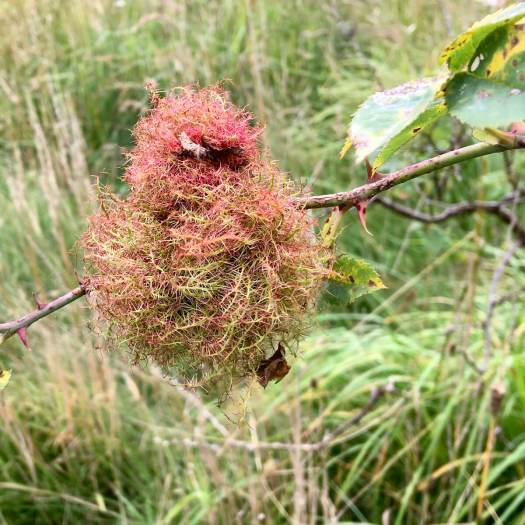
Some rose diseases are so easily spread and devastating that I have a horror of them (rose rosette disease or crown gall of roses, for example). On seeing these mossy galls, despite the overactive alarm message, ‘Do not touch!’ flashing at the forefront of my mind, I did get close enough to take pictures. I vaguely remembered what these fuzzy growths were but needed to look them up to be sure.
I need not have been so alarmed: Rose bedeguar gall, known as Robin’s pin cushion or mossy rose gall, is neither a disease nor as harmful to the rose as might appear.

It’s as if the rose has become bewildered at a certain point. It doesn’t know which way to turn, but carries on trying every which way, putting out a mass of feathery feelers that wrap themselves up to form a wispy, mossy green bundle about the size of a golf ball. Less commonly, the galls are bright red and green, as on this plant.
What has happened is that a gall wasp, Diplolepis rosae, has buried 30 or so eggs in a bud or cluster of newly emerging leaves. Each egg has chemically instructed the rose to produce a gall around it, which fused with its neighbours to make a multi-chambered cluster. When the larvae hatched and started to nibble, the rose was stimulated into providing rich food supply of carbohydrates and proteins .
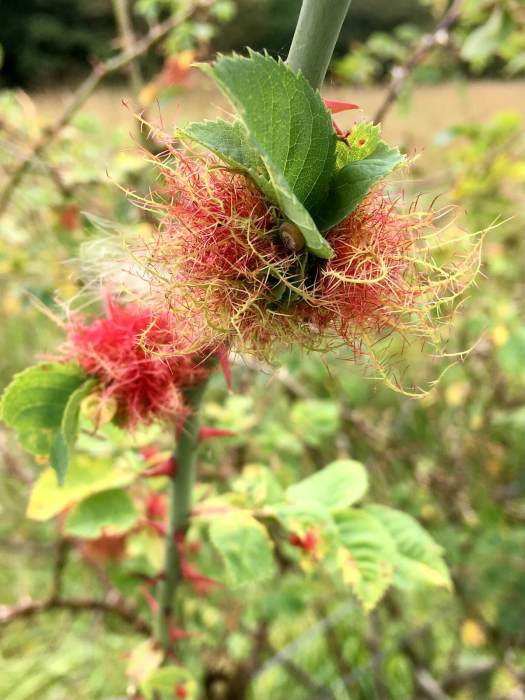
A cross section of a mature gall would reveal a woody interior dotted with cavities eaten out by the developing larvae. Later in the season, the moss galls brown as they harden and dry. The larvae overwinter snugly in the gall, protected from exposure to wild weather or predators. If all goes well, they’ll pupate in spring then emerge from May to August to lay eggs (over 99% are female). The wasps are tiny: two of the larger females would easily fit lengthways in a centimetre (and six head to tail in an inch).
While the galls are sometimes found on domestic roses, they are most commonly found on Rosa canina and other species roses growing wild. This was a spindly plant growing in an exposed spot on the edge of farmland between Hoddlesden and Belthorn in Lancashire.

If you find a few mossy rose galls on one of your roses, they’ll not do much harm to the plant unless it becomes a severe infestation. Roses coexist fairly amicably with worse. So the choice is yours – to celebrate diversity and the miracles of nature and let them be, or prune them off.
October will be another fun month of squares and Becky is driving the bus in more ways than one. Her topic is so broad that any post in the whole of the blogosphere will qualify, provided that at least one of the photos is square. For details of how this can be so, check out her blog. Today I’m illustrating spiky.
 Susan Rushton
Bad hair day.
Know the feeling.
Oh the travails of being a gardener. But I bet you’re inside today!
Good guess! My sweetheart and sister don’t mind roaming the moors in the rain, but I’m more lily-livered.
Me too. Mud is My Enemy.
I recall seeing these on a walk earlier this year, find them amazing. You’ve captured them brilliantly, a great past squares
Isn’t nature strange? Fancy a rose becoming a nursemaid.
So much more to roses than their name!
So fascinating. Have never seen this, but now I know.
Thanks, Derrick.
I’ve seen birds pecking at these galls, so now leave a few on the red-leaf rose (R. glauca) that seems susceptible to them.
Rosa glauca is a great rose – yours will be even more characterful.
Fascinating – and excellent – photographs!
Thank you!
They actually look very pretty – or at least your photos make them seem so, great spiky squares too!
Perhaps these red ones are pretending to be roses and just need a millennium or two to perfect their disguise.
I knew that I didn’t know much about roses, but this absolutely boggles what’s left of my mind. What an amazing device this is! Is it soft or is it as sharp as it looks? Most impressive the way it picks up the pink of the thorns! Lovely photos!
I did not dare touch it. Some of the rose diseases spread like wildfire and until I know what strange things on a rose are, I keep my distance. The tendril bits looked soft but they do harden later.
This sounds very creepy to me. But then again it is new and strange for me so not a big leap to creepy. I wonder if they are here in the US.
I haven’t seen them often and never so far as I remember in the US.
I never saw that before.
They reminded me of the seedheads of love-in-a-mist, taken to extremes.
Fascinating post. I, too, have never seen these galls. Love the concluding sentence.
I’d have liked to see one of the wasps, although I wonder if I’d have dismissed it as a fly.
Wow! I’ve never heard of this before, but it’s very beautiful. Thanks for sharing about it.
They were striking at this stage, with the red colouring too.