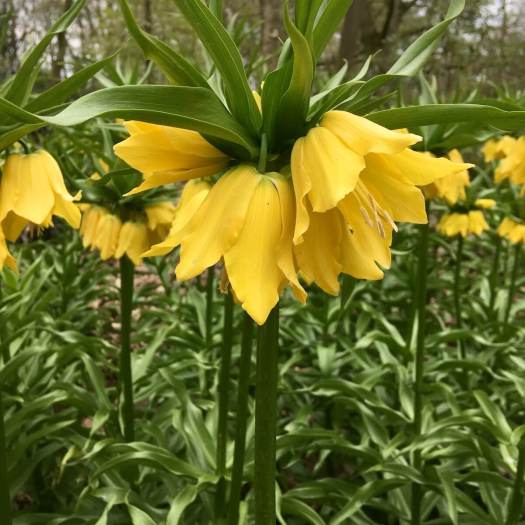
Fritillaria imperialis are very attractive in flower, although they are decidedly pongy when grown in a big group. Folk names for them include Crown imperial and imperial fritillary.
Walking around a woodland garden last spring, my nose picked up something foxy in the air. I thought I knew what it was, but not where it was coming from. By following my nose, I eventually tracked down this clump of flowering bulbs, a bit deeper in the woodland.
Fritillaria imperialis is a stately plant. Bell shaped flowers dangle in clusters at the top of a sturdy stem, the crown of flowers itself crested with a mop of leafy bracts. I can understand why the golden yellow ones would prompt the comparison with a crown, although their tousled character gives them a sheepish look: the llamas of the plant world, perhaps.

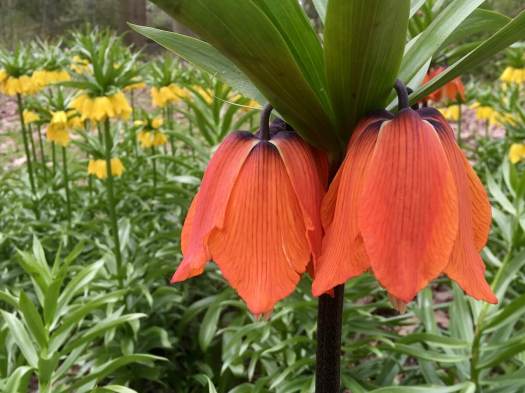
I loved the distinctive brown markings on these orange plants. Sadly none of these were labelled so any identification would be a guess.
Yellow ones are commonly sold as Fritillaria imperialis ‘Lutea’ – F. imperialis ‘Maxima Lutea’ is an award winning, improved variety. Orange ones include F. imperialis ‘Maxima Rubra’, F. imperialis ‘The Premier’ and F. imperialis ‘Aurora’.


I found a supplier describing them as having ‘a distinctive musk-like odor’, and suggesting they are combined with fragrant daffodils.
All I’ll say is, good luck masking that scent!
Shared for Becky’s SquareTops – I’m claiming their quirky green crest counts as a topknot.
 Susan Rushton
They are beautiful. I’ve not seen anything like them around here.
You’d remember them.
I think I would.
I don’t remember the smell being particularly unpleasant. My parents had the regular yellow ones in their garden many years ago.
It might just have been that there were so many of them, or I suppose they could have been in the haunt of real foxes. 🙂
It may also be me. I don’t find skunk that unpleasant. The only time I remember skunk bothering me was when one sprayed outside the bedroom window on a hot summer night when the windows needed to be open.
Let’s just say we have different tastes in fragrance. 🙂
That’s something that never occurred to me until now. A lot of people around here say you will smell a black bear before you see it but I don’t remember ever smelling one.
Have you seen them, though or have you managed to keep clear?
Oh, I’ve chased them out of the yard and had then cross the road/trail in front of me when out for a walk. I must have walked close to one in the dark last year. It was tearing the door off the garbage shed before I was out of the driveway going for the sunrise. I had to walk past the garbage shed to get to the car.
I love bell shaped flowers!
I like them too.
Wow!
Each one is a little explosion of colour.
The close up of the orange is stunning – like chocolate!
It’s interesting how the stem is striped on that one too.
wow these are not like the frillaria I normally come across, no wonder they are imperialis. Beautiful photos
There are some quite weird fritillarias, as if they do not feel constrained by the colour combinations or the forms we expect and are better for it.
I think the first time I ever saw fritillaria was on your blog. I love the name! I’m not sure I could be enthusiastic about a “foxy” smell, but I could be enthusiastic about admiring them from a respectful distance. They certainly are dramatic.
You might need binoculars – in my experience you can smell them before you see them.
I haven’t seen anything like that in Maine, either. A striking flower. Too bad they smell as nice as they look. We have a little trillium that is nicknamed Stinking Benjamin. But it only smells bad if you sniff it, which we take care not to do.
I’ve never noticed anything unpleasant in Hellebore foetidus either, but as you say, I don’t set out to sniff them. These are distinctive – not my idea of fragrant.
I remember my mum growing these as house plants. Never one of my favourites I have to say.
That made me smile. They are beautiful but I wouldn’t care to live with them.
Certainly rewarding to grow. I have visited this Manor.
They make a real splash of colour and their form is very attractive too.
They are both lovely
It does make you wonder about evolution when you look at these.
I have three of these bulbs (orange flowers) but they have never flowered. As soon as the foliage appears above ground it gets eaten. I think I shall dig them up – again – and try planting them on one last spot. And if that doesn’t work then they’ll go into the compost.
Is it the slugs that get them?
I guess so. 😞