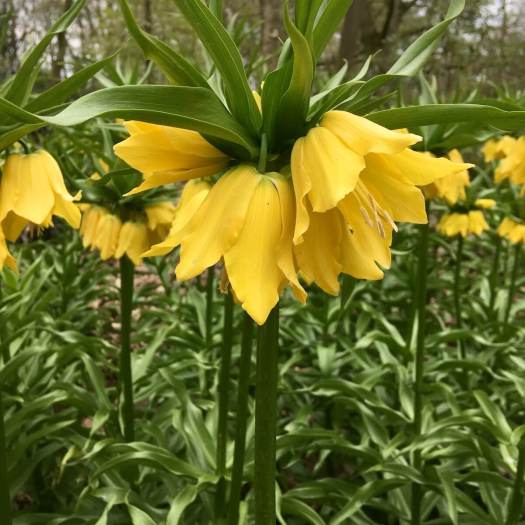
Fritillaria imperialis are very attractive in flower, although they are decidedly pongy when grown in a big group. Folk names for them include Crown imperial and imperial fritillary.
Walking around a woodland garden last spring, my nose picked up something foxy in the air. I thought I knew what it was, but not where it was coming from. By following my nose, I eventually tracked down this clump of flowering bulbs, a bit deeper in the woodland.
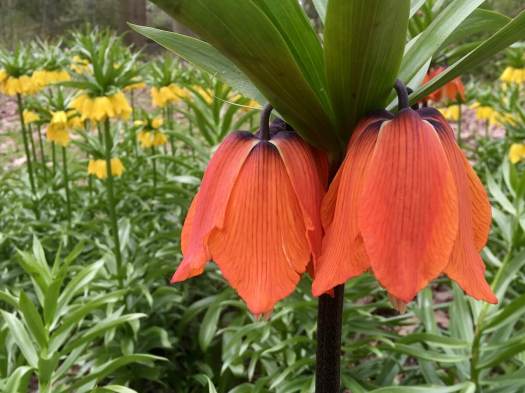
Fritillaria imperialis is a stately plant. Bell shaped flowers dangle in clusters at the top of a sturdy stem, the crown of flowers itself crested with a mop of leafy bracts. I can understand why the golden yellow ones would prompt the comparison with a crown, although their tousled character gives them a sheepish look: the llamas of the plant world, perhaps.

I loved the distinctive brown markings on these orange plants. Sadly none of these were labelled so any identification would be a guess.
Yellow ones are commonly sold as Fritillaria imperialis ‘Lutea’ – F. imperialis ‘Maxima Lutea’ is an award winning, improved variety. Orange ones include F. imperialis ‘Maxima Rubra’, F. imperialis ‘The Premier’ and F. imperialis ‘Aurora’.


I found a supplier describing them as having ‘a distinctive musk-like odor’, and suggesting they are combined with fragrant daffodils.
All I’ll say is, good luck masking that scent!
Shared for Becky’s SquareTops – I’m claiming their quirky green crest counts as a topknot.
 Susan Rushton
The orange crown imperials are the only fritillaries that I really like. I can’t say I’ve ever noticed the scent, though.
It might have been the sheer numbers – it was a good clump – or perhaps the wind was blowing towards me.