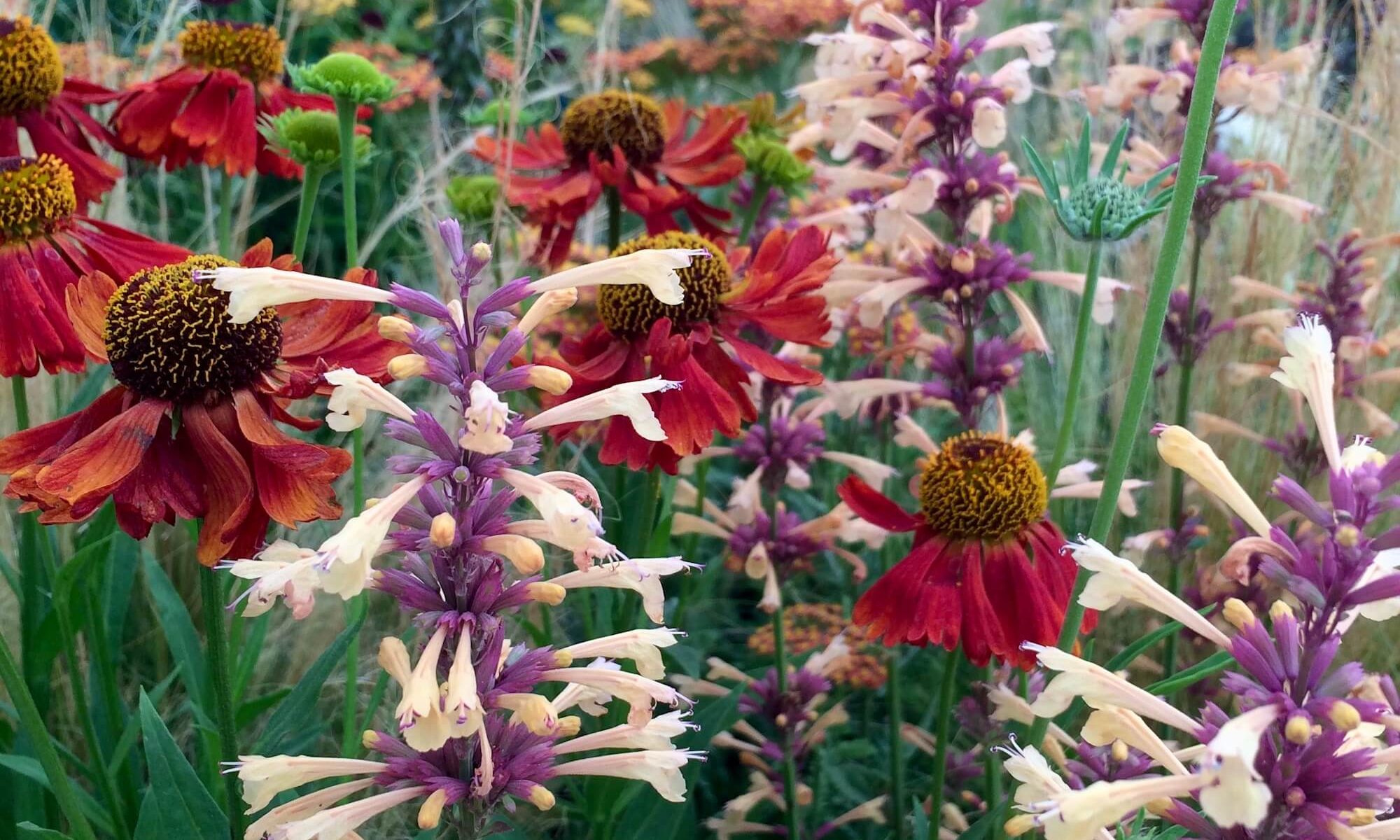
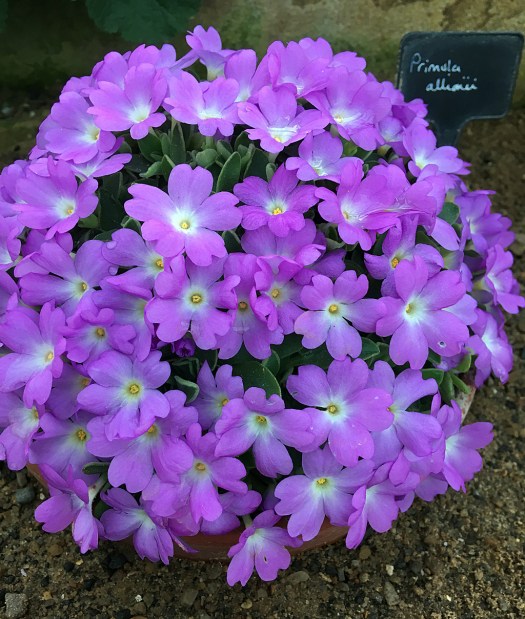
The northernmost of the Royal Horticultural Society’s gardens, Harlow Carr, has so much to see that most repeat visitors must feel torn about where to go first. Not me – the Alpine House draws me in like a magnet. It’s show time there, whatever stage of the year. The gardeners tend a stock of plants behind the scenes, picking out tiny treasures when they are at, or around, their best for their turn in the Alpine house spotlight. This week our treats included several primulas, some flowering so madly that their leaves were hidden, others wearing their leaves with pride.
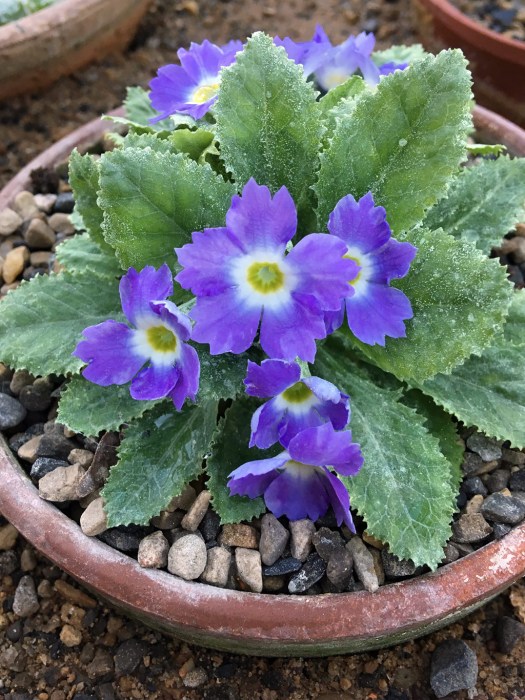
Some of the plants in the Alpine greenhouse are inside because they need protection from cold, wind or rain; others would grow outside just fine. Common species plants are treated as carefully as rare or special cultivars, all raised up on broad, sweeping benches so we can admire them at close quarters. Plants are grown in traditional clay pots, sunk into a mixture of sand and sharp grit to help keep the roots cool and stop them drying out too quickly.

When I’m out enjoying snowdrops in a collector’s garden such as Rode Hall or Colesbourne Park, I’m always on the lookout for yellow ones. I typically find them (when I do find them, which isn’t often) by remembering to pay careful attention to the puniest looking ones, stooping down by any feeble specimens, then gently pushing aside one of their outer petals to find out whether their markings are yellow. Galanthus ‘Primrose Warburg’, a fine specimen, bucks the trend by having sturdy, strap-like leaves and large flowers. A yellow ovary at the top helpfully signals its difference – the snowdrop equivalent of a belisha beacon.
The colour is golden lime rather than a soft primrose yellow: the name celebrates snowdrop lover, Primrose Warburg, who had some in her Oxford garden. Country Life credits her passion for seeking out unusual snowdrops and sharing them with other galanthophiles at high society snowdrop lunches for making snowdrop scrutiny so fashionable.

Another boldly coloured flower on display in Harlow Carr’s Alpine House on the day of my visit was Scilla ‘Spring Beauty’. It’s part of an advance party: in a few weeks the woodland garden outside will have a host of scillas, as Wordsworth might have put it.

The advance daffodils are here too, but none looked more golden than this little mound of flowers. Someone set out to pink all the edges with pinking shears, but found they could not keep up with the task.

Cyclamen coum is one of many common plants that delight, viewed up close. This pot has a good selection of colours from white to cerise, many with that hint of picotee that helps them glow.

This pearly green hepatica with purple embellishment is a favourite of mine. Fantasia in miniature, the flowers rise triumphant on wiry stems over burnished red foliage. I shared another picture of this plant in last year’s post and trust this time won’t be the last.

Harlow Carr has thousands of small irises in flower outdoors at the moment in various combinations of blue, purple, yellow and white. Iris ‘Blue Note’ is the richest and most velvety of all the ones I saw on our visit – more purple than blue, it’s almost black in parts. The rising petals have a silky sheen.

Named for one of Harlow Carr’s sibling gardens, RHS Wisley, this Spring starflower has wonderful movement in its strap shaped leaves making the irises above seem positively straight laced. You could call this diminutive member of the onion family, an AGM (Award of Garden Merit) winner, a master of disguise in that it has previously passed under several botanical names, including brodiaea and triteleia. Who knew plant fragrances could have bathos? The flowers smell of violets but the leaves are onion scented if crushed.
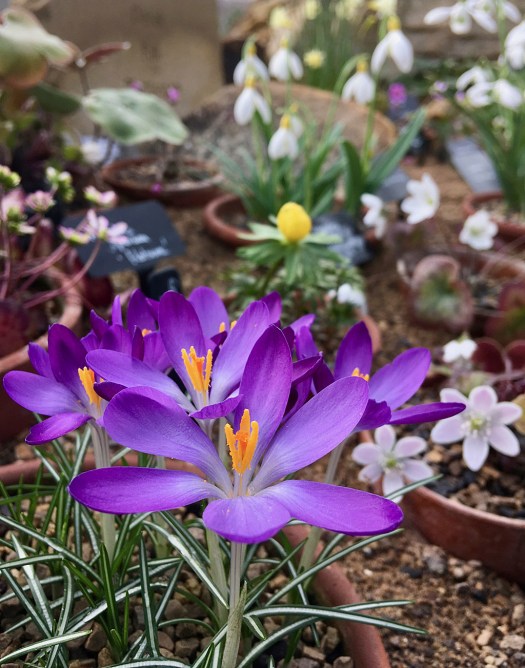
These crocuses are my tenth selection. I love the silvery stripe that adds weight to each slender leaf and their eagerness to offer their pollen to passing pollinators. I originally chose this shot so you could glimpse the other flowers in the background as it gives a clearer impression of the Alpine house than close ups of flowers permit. Looking more closely, these crocuses seem to carry within them everything we flower lovers secretly envy: the ability to simply be what they are, and to unashamedly glory in it.
 Susan Rushton
To be what they are, and glory in it. Oh, yes! The tiny things do that so well! I was smitten by the snowdrop with the yellow top-knot and of course I had to look up Belisha beacon because I had no clue. I also had to stop and ponder the concept of bathos in plant fragrances. And I very much appreciated the wider view of the Alpine house behind that last crocus. But that ‘Blue Note” iris absolutely took my breath away — I don’t know that I’ve ever seen a blue like that in a flower. Or anywhere else, for that matter. It’s no wonder you make a beeline for the Alpine house!
I like to see it first and then go back just before I leave, in case I missed anything. An alpine house is the greatest luxury for a gardener (assuming for a moment we set aside the more achievable bread and pie definitions of luxury which serve us so well).
“Bread and pie definitions of luxury” — ! Another new one on me! Is that a Susurrus original or is “bread and pie” a common term in the UK?
Bread and pie luxury isn’t a saying (unaccountably). I was meaning how tasty bread or a nice pie are great luxuries, if only we take a moment to realise it.
I could not agree more! I also think it’s a great saying. I hope you’ve started something with it!
The phrase is new to me, too. A search on Google just now for “bread and pie luxury” turned up no hits, so it seems you’ve come up with something original.
Oh, how beautiful are your harbingers of spring!
An Alpine house does allow us to travel forward in time a few weeks. 🙂
All lovely, but that iris is a stunner. Holy cats!
I remember blinking with surprise when I noticed the iris, thinking “Did I really just see that?”
I bet!
Another beautifully photographed and described visit
Thanks, Derrick. I’m glad you liked it.
I agree these little treasures are bewitching. I wish the more unusual hepaticas weren’t such eye- watering prices.
The small size of the plant makes the eyes water a little more!
The alpine house at HC is wonderful. We visited the Alpine Society show at Pershore on Saturday, the quality of the exhibits was outstanding.
I would have loved to have seen that.
I love Harlow Carr. I love the woodland areas best but you are right – I never know where to go first
I like the steamside garden a lot, especially when the primulas and blue poppies are in flower.
I went to Harlow Carr for the first time last Friday. My favourite was the Alpine House. The crocuses outside were lovely too.
It’s great isn’t it?
Yes.
Hepatica japonica ‘Hatsune’ is a beauty. I have recently planted some blue ones Hepatica ‘nobilis’ in the garden. Hope they survive! And that iris colour is divine.
I hope they do too. Hepaticas are some of my favourite flowers, I had some I grew from seed in a pot for a long time, but they eventually melted away.
I just worry they will be eaten, they look so delicate!
It’s amazing how many colours and forms there are, given the flowers are so small, but you’re right, they all look delicate.
SO lovely! ❤
Thanks, Eliza 🙂
Are the flowers of Cyclamen coum normal for the species? They seem big to me, but I have no experience with this species.
I would say so. A close up shot exaggerates the size. They are less than an inch.
Oh, of course.