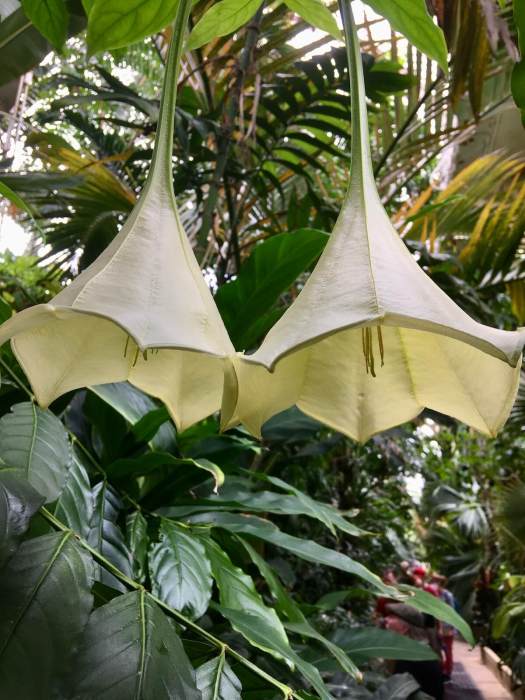
Last month I was lucky to see a rare tropical shrub/small tree, Osa pulchra, in full bloom. Huge, trumpet-shaped flowers hung just overhead, still and improbable, translucent against light pouring through the magnificent high roof of one of Kew Garden’s conservatories.
At the time I didn’t understand what I was looking at, but I knew it was special. To an observer I must have appeared like a human version of the His Master’s Voice dog.

Slender green stalks merged into architectural creamy-white flowers, constructed from sturdy petals fused together to create five sections. The glossy leaves had wavy margins and deeply embossed veins that presumably act as water channels. As the leaves are slightly pendulous, the plant seemed to sigh.
Challenging to grow and endangered in the wild, Osa pulchra is most often seen in botanic gardens. Only cuttings taken from the top of the plant will root, causing obvious difficulties.
Searching for more information, I quickly came across a Google-selected summary from Wikipedia advising, ‘The plant is most easily propagated by seed’, followed closely by a site selling the seeds at $10 a pop with the warning ‘Not for beginners’.
More determined searching unearthed an expert’s 400-word testimony to the challenges of growing from seed. At best, 16% of his hand-pollinated seeds could be persuaded to germinate and ‘chopstick midwifery’ was often needed to try to ease the sprouts out of their seed coats quickly enough for the first leaves (cotyledons) to start photosynthesising before the seedlings ran out of energy and collapsed.

I’d have loved to sample the heady night-time fragrance which is designed to draw bats into this great pavillion of a flower.
Imagine what it must be like to experience a grove of wild Osa pulchras flowering in Costa Rica – a tropical moon garden.
Shared for Cee’s Flower of the Day.
 Susan Rushton
As always, I was as intrigued by your comments as by the flower. Pulchra indeed! I think I startled the early-morning ducks, though, with my guffaw as I read your line about “His Master’s Voice.” That is my big objection to flowers that hang like that: I have to stand on my head to see them. Wonders like this one certainly teach us why we need botanists and conservatories. I hope there will always be midwives to protect this gorgeous being.
Your ducks deserve no better. I wonder whether the help of botanists is helping to pass on the sticky seed coat genes. With so few plants to choose from, I suppose needs must.