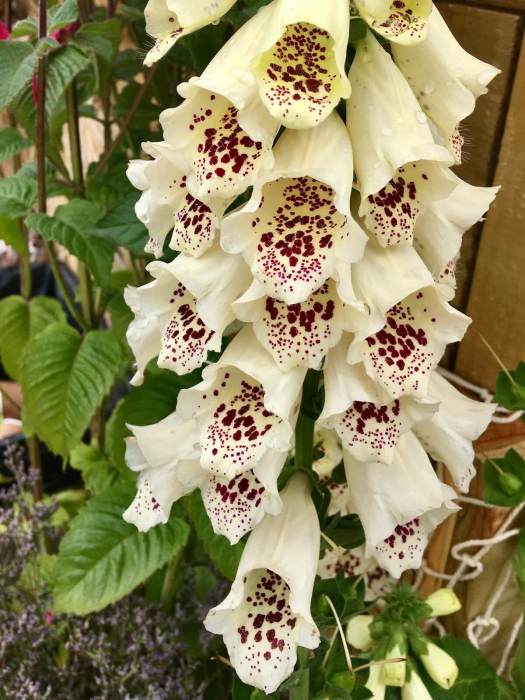
In contrast to my recent post celebrating wild foxgloves, here’s one of several garden forms of Digitalis purpurea with cream flowers and maroon spots.
The foxglove pulls off the trick of being sturdy and fairly compact without sacrificing its elegance. Each throaty tube has a wavy edge, together giving a lacy or lightly frilled effect. The insect landing patterns are alluring: lighter spots at the lip of the flower lead to broader splotches then to a speckled effect that tapers out at the business end of the flower.
Comparing the florets made me wonder if each has a unique fingerprint – or perhaps that should be throatprint. One of the weird, wonderful, counterintuitive characteristics of our world is that infinitely varied things exist.
We know that every human is unique, even from her twin, but society tends to think of types of plants and animals as being broadly identical. We treat waterways and patches of wild land as if they were broadly identical. Would more value would be set on each one lost if we believed every one was unique and irreplaceable?
Crafts-based industries that still co-exist with and compete against mass-produced products do so on the basis that hand-made, subtly varied products are worth more. A logical use of machine intelligence will be to shift some industries away from mass producing identical products to mass producing non-identical ones within looser parameters. Teddy bears, each one with a different set of facial features and expressions, as if hand-made. Dolls designed to appear to be a child’s sister or brother. I’m not actually proposing that this is a good idea, but noting what will surely happen, if it is not already.
I think I should have stuck to celebrating the foxglove, don’t you?
 Susan Rushton
Well, this post certainly took on a somber turn, but you make excellent points. Great harm can be done and justified by lumping people and other living things into into featureless groups. But on a happier note…foxgloves surely are sturdy and elegant, not a natural pairing.
I indulge myself in some posts more than others and think, well, it’s my personal blog after all! Although our wild creamy white ones are elegant, they are given to tumbling over.
We’ve witnessed this dynamic before. See: responses to Gutenberg’s printing press, and William Morris’s contentions with changing tastes. I can only imagine what William Blake, with his New Jerusalem and poetic screeds against the Albion mills, might have thought of AI. It’s going to be an interesting few years.
As for a larger view: when I first began to pay attention to the natural world, I quickly learned that there are ‘lumpers’ and ‘splitters.’ The splitters, of course, often become taxonomists, while the lumpers, for all their loss of fine distinctions, still are capable of saying, “Oh! Pretty foxglove!”
I’m not sure which I would qualify as. I do notice details, but can probably lump with the best of them!
That is a particularly beautiful foxglove!