
Early autumn is a great time to hunt for fungi, so I have spent some time searching for the most atmospheric of all, red and white spotted toadstools, in all the likely and less likely places I could think of near where I live. As often happens, when I was not searching, I glanced up and had the thrill of seeing twenty or thirty of them growing on a hillside in a narrow strip of mixed, light woodland on the edge of peaty moorland.
Toadstools are the fruiting bodies of underground mycelial networks. Happy to return to earth, they emerge only briefly after a rain, swelling rapidly to full size then rotting back after releasing spores from white gills on the undersides of their caps.

My happy discoveries were forming an uneven, broad, very gappy ‘circle’ that encompassed two birch trees. Romantics say that mushrooms and toadstools appear in rings where fairies have been dancing hand-in-hand. Darwen’s fairies are very sure-footed if so, as the incline is ill-suited for dancing. I suppose that’s what wings are for.
Science tells us that rings form because the fungi deplete the soil of the elements they need to thrive. By dying out in the middle and producing toadstools at their outermost edges, future generations can gradually spread in wider and wider circles over new soil.
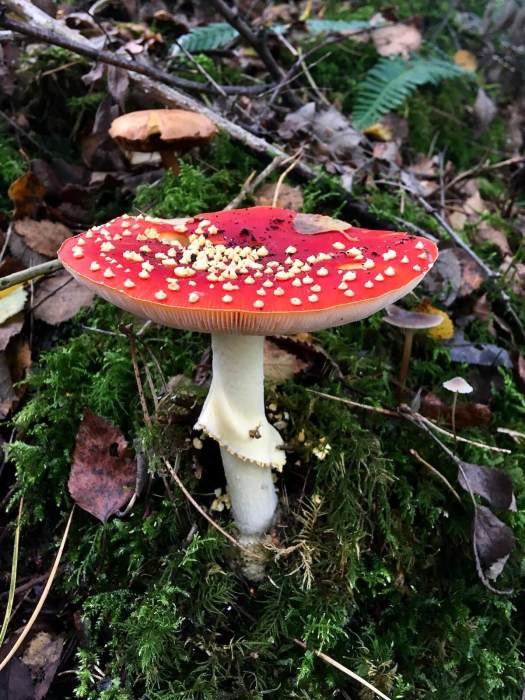
At first sight, there seemed to be at least three types of red ones: plate-sized toadstools with flattish caps on 12-15 cm / 5-6 in stems, with and without spots, and short ones with dome-shaped caps. A distinctive fragrance hung over them.
It is notoriously tricky to identify fungi and mistakes can kill. Individual specimens vary and change colours and shapes as they mature. Having checked and double-checked, all three ‘types’ were different stages of the same toadstool which has the folk name fly agaric and the scientific name Amanita muscaria.
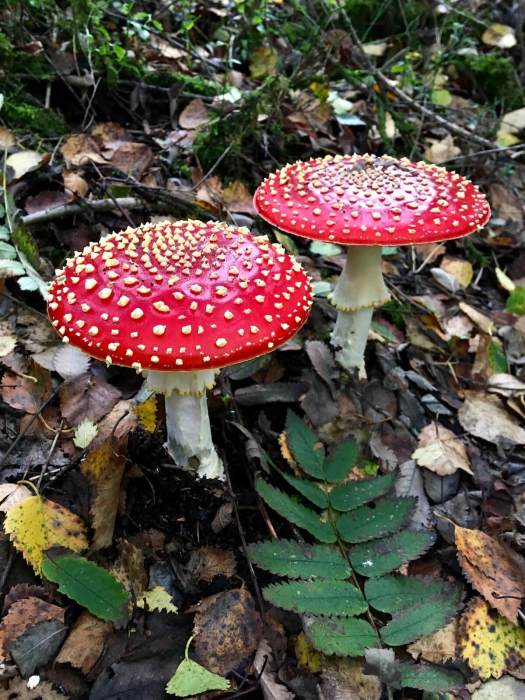
Over the next few days, I watched the caps of the smallest ones expand, their stems lengthening so their ragged skirts could be seen.
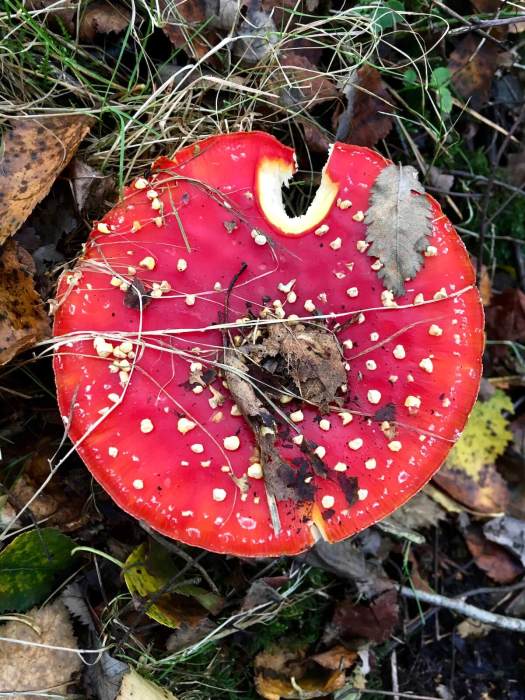
A fly agaric’s spots are not flat, as you might imagine if you’ve only seen them at a distance or in illustrations, but are raised, irregular remnants of the universal veil that protects the developing toadstool and so can wash off, given enough rain.

At this time of year the mosses, wimberries and ferns are littered with fallen leaves, dried up grasses and twigs. Many of the fly agarics had emerged carrying some kind of topping from the woodland floor. Others had caught debris as the caps thickened and were turned into a shallow dish shape by the developing gills.
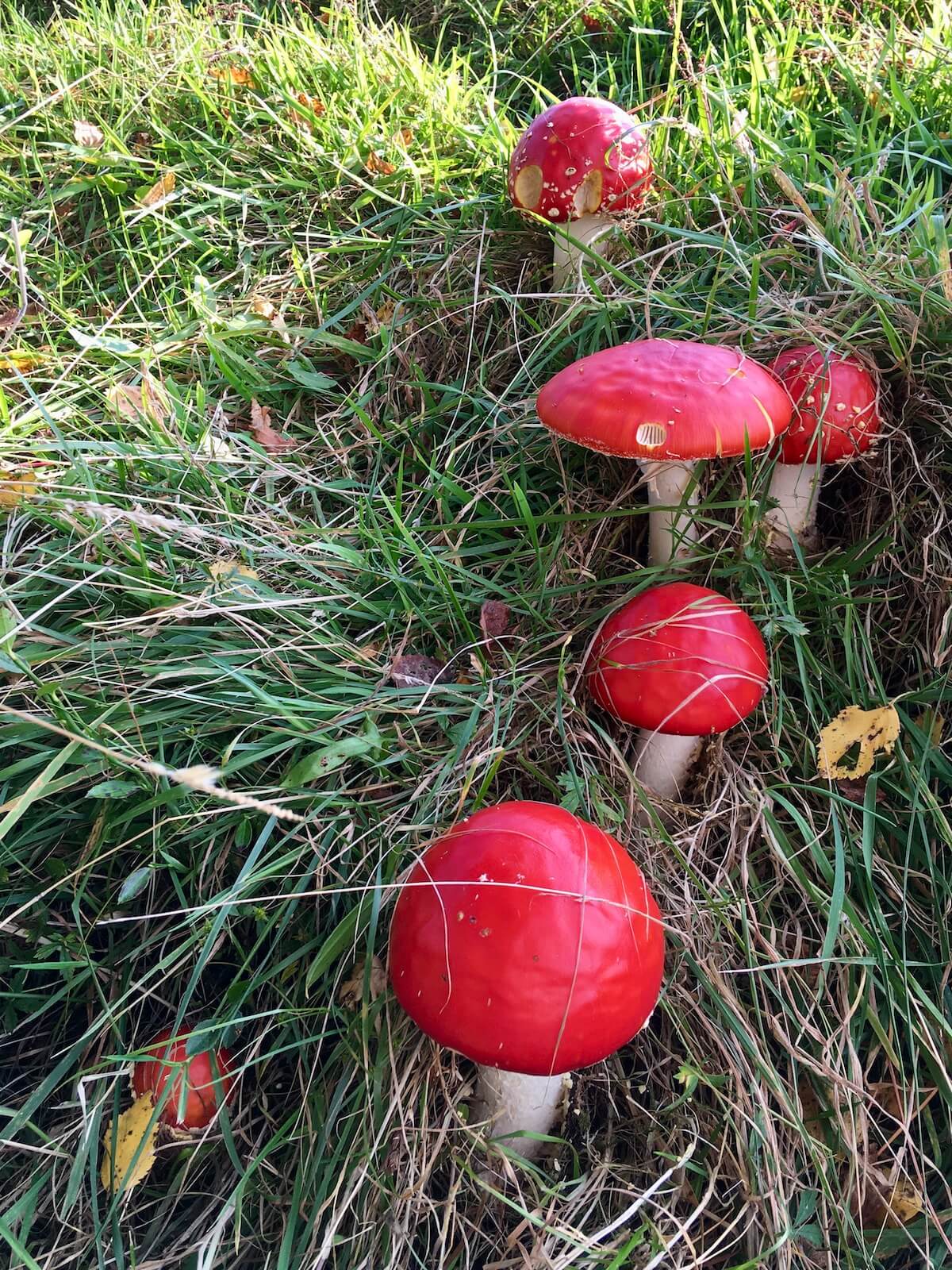
Although fly agaric toadstools are classified as common, common is relative. Mixed woodlands with birch trees are a good place to look. I’ve very rarely seen them and certainly never such a fine group as this.
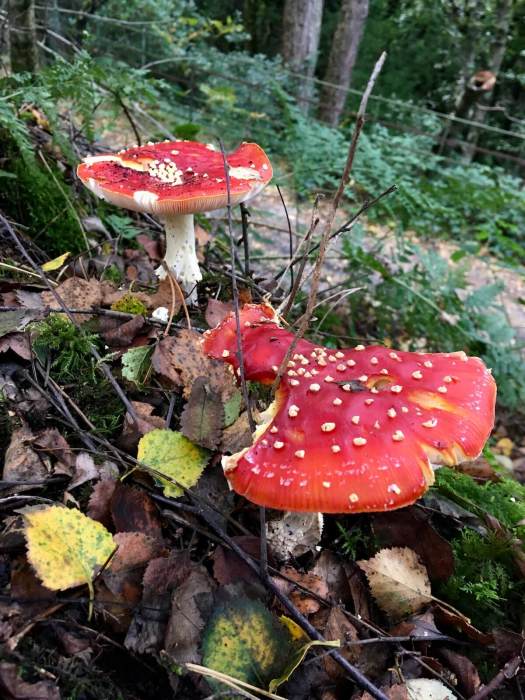
I enjoyed seeing their pull on passers-by who noticed them and marvelled how others strode by without seeming to notice.
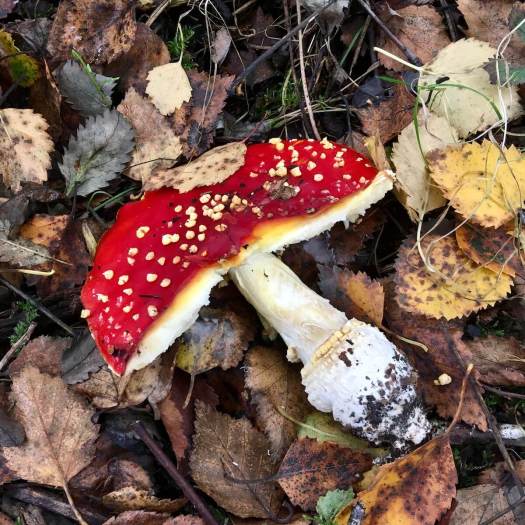
The uprooted one shown in my last picture reminded me most of illustrations in children’s books.
Mysterious, strange and most certainly to be respected, fly agaric toadstools are poisonous and hallucinogenic. Sacred in some cultures, they are prepared for rituals in others. Need I say I did not pick any?
Shared for this week’s Lens-Artist’s Challenge: Treasure Hunt.
 Susan Rushton
These are wonderful fungi Susan. A lucky find 🙂
It was luck, especially as I’d been tempted to go the other way.
Beautiful fungi. A bit balloon-like.
The small ones are quite spherical, but they soon flatten.
Beautiful yet poisonous. Undeterred, the fairies dance around the toadstools. Perhaps some day you will catch a glimpse of those whirring fairies. Just don’t let them see you.
I did pause to wonder when I discovered I was inside a circle.
Perfect examples of aposematism!
I wonder what tomatoes are trying to tell us?
Beautifully captured, Susan! They are the mushroom of fairytales seen along Little Red Riding Hood’s path. Interesting to learn the why behind the circles. We get the orange version here, not as striking as the red. I wonder if the things that do eat them have a ‘religious experience?’ 😉
I’d love to see the orange ones and there are yellows too. Reindeer are said to have a liking for them so perhaps these are what fuels Santa’s sleigh.
That may be the basis of the myth!
How funny that I too included a fly agaric in my post today. I second that about taking care with your mushrooms. Our lawn was full of – apparently – field mushrooms, but I hesitated because I thought the gills were too pale, and they didn’t smell ‘mushroomy’. Phew! By checking, rather than making a mushroom risotto, I saved us from a 60% chance of death.
Phew. You were wise not to play risotto roulette with such bad odds.
Indeed! Still here …
I’ve never seen so much color in a mushroom like these have. We have them growing wild everywhere, but nothing even remotely close to this species.
We have many different kinds too – I suppose anywhere damp will have. I found some splendid brown ones and two fleeting forests of really cute tiny ones that seemed to be here today, gone tomorrow.
Brilliant spot! I’ve never seen one in real life. Perhaps I should go on a hunt too! Interesting post, especially the info about the white spots on the caps.
It is worth having a look under any birches you see at this time of year. I hope you’re lucky!
Beautiful but deadly poisonous! What a dangerous combination!
Quite! They are not our deadliest, but they are surely some of our most beautiful ones.
So beautiful yet so poisonous. Just the stuff for fairytales!
That combination is guaranteed to fire up the imagination.
Exactly: that’s what wings are for! I much prefer the older explanation to the scientific explanation for the circle. Such wonders cannot so glibly be explained by things like soil nutrients. These are beautiful, especially among the leaves and twigs, which set them off with a certain eloquence, I think. I was glad to read you kept your distance. I was also glad to acquire a new word: aposematism, thanks to the comment above. Now if I can only remember it…
Some words really do need to consider taking steps to be more memory-friendly if they want people to use them.
Absolutely true. It’s the words’ fault that I can’t remember them!
You’d almost have thought whoever invented that one wanted hardly anyone else to know what it meant. If it had been go-away-glads (as in glad rags), we’d all be remembering it.
Linnaeus should have consulted with you!
They certainly are beautiful, and the extra information is fascinating. It’s so dry here it will be a long time before we ever see another mushroom, toadstool or any other kind of fungus. I just xeriscaped our whole yard.
We had an unusually dry summer too.