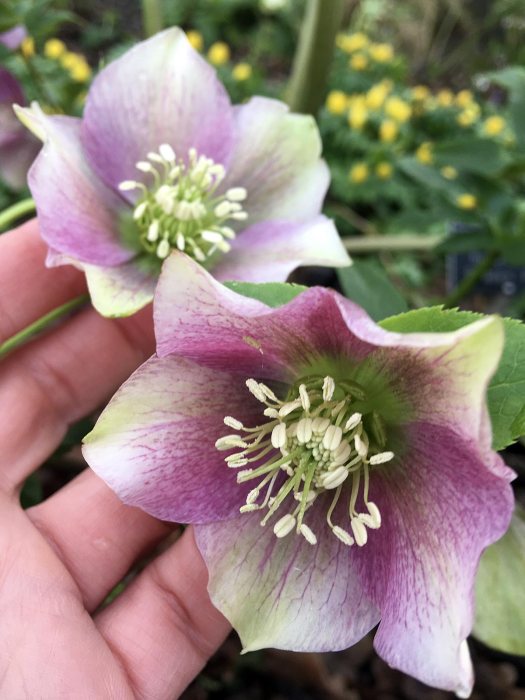
Although we think of hellebores as having petals, technically they are sepals, which accounts for their flowers’ longevity. This single hellebore is one of my favourites I’ve seen this year.
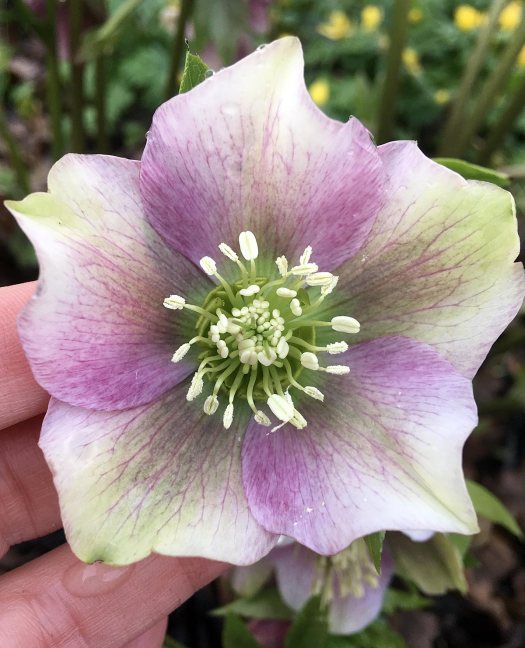
Looking inside, the veining is soft. Pink patches on the left and right of each sepal almost form a star shape.
Single hellebores have a ring of tiny, flattened tubes called nectaries around the base of the stamens. In the first flower, they are green.
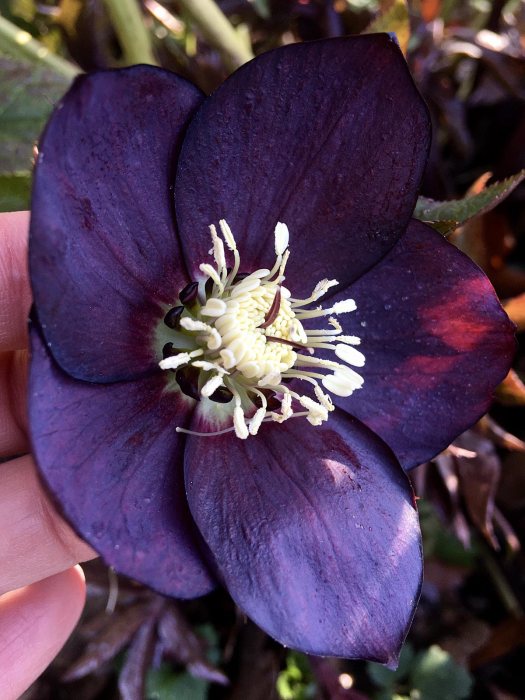
In the dark purple hellebore the nectaries appear black against the pale green centre.
Nectaries are petals that evolved by shrinking and curling to form tiny containers for nectar to attract pollinators. Natural yeast in the nectar ferments, adding to the allure (don’t think of sampling the nectar: all parts of hellebores are toxic to humans).
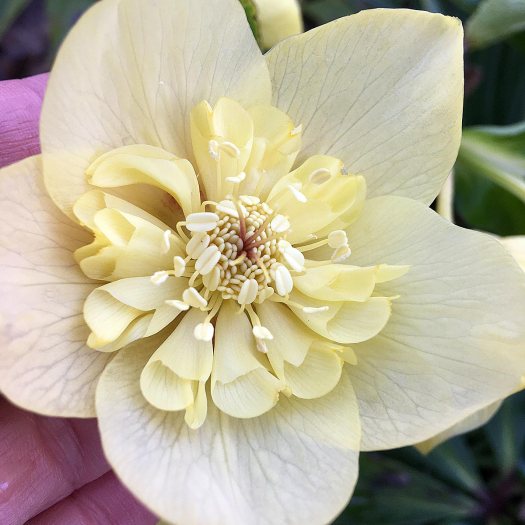
In doubles and semi-doubles, this process is gradually reversing, often with human intervention as breeders seek out novelties. The nectaries elongate and turn more petal-like, as in the primrose yellow semi-double hellebore above.
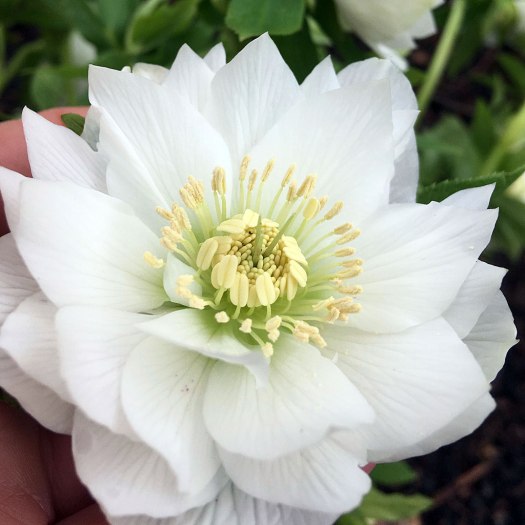
Double hellebores have lost their nectaries completely. But for the tiniest smattering of spots, this one would be pure white.
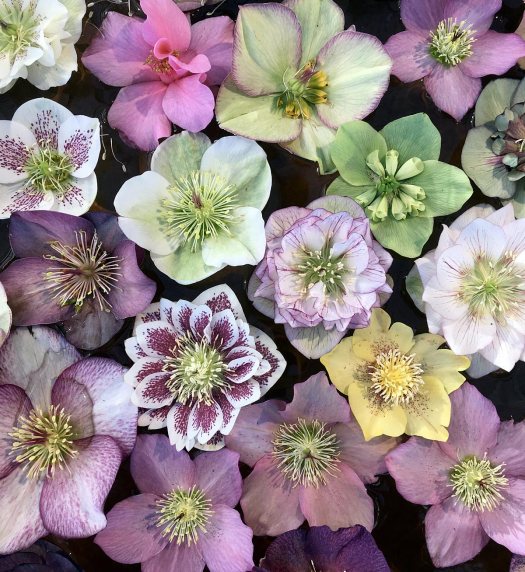
From above, it’s hard to appreciate the variety in today’s plants as their heads hang downwards, so many gardens float different colours and forms of hellebores in a bowl for visitors to admire. This selection of singles, doubles and semis is from our trip to Wisley last month. It was only later that I noticed that one of the flowers is a camellia. It’s so obvious once you see it.
 Susan Rushton
Those semi-doubles and doubles are gorgeous and so are your photos.
Thanks, Vicki.
My hellebore never looked so good. Clients purchased as many as we could grow anyway.
I usually share the exceptions I see. My mum has a purple one I grew from seed over a decade ago. It is packed with flowers – perhaps sixty or more. You need to cut back the last season’s leaves though to really appreciate the flowers, which is perhaps not always practical when they’re used for landscaping.
Those who do not know what they are do not mind cutting them back. I like to think that most of mine went to gardens where they were appreciated. However, I suspect that landscapers just installed them because they are trendy, and left them in gardens where they are not appreciated or maintained properly. Those that I work with now grow like weeds, but are not very pretty. I can not bear to replace them though, just because several people recognize them and appreciate them.
Thank you for that explanation, I have learnt something new yet again. The hellebores floating in the water look ravishing; such a wealth of colours and formations.
I was so surprised to see the camellia. You would have thought I’d have spotted it right away. I was in a hurry at that point as we had to set off for the station.
Very interesting – I learnt something new. (Now I know about the nectaries, I can describe the flowers better…) Hellebores are the loveliest flowers at this time of year and it’s a pleasure to see yours! 🙂
It’s lovely to be able to share them.
So gorgeous, such a great plant and your favourite is certainly special!
I’m glad you like that one too.
These are so pretty.
Where would we be without flowers?
Beautiful! and such an interesting feature of these flowers.
My favourite is the semi-double yellow – love the shape of the petals.
I have a soft spot for the yellows too.
They are heavenly … and that purple hellebore is just divine! Mind you purple is my favourite colour 🙂👏
I can understand why – purple is rich and atmospheric.
Thank you once again Susan! I have been working on my embroidery skills and your pics are such an inspiration..love them all!
My pleasure!