I am usually drawn back to my favourite gardens at least once each year, timing my visit when they are at, or around, their peak of flowering. That can be a challenge. Seasons vary. Enlightened gardens work hard to make sure there is always something to tempt visitors during their open season, which makes ‘their peak’ relative, depending on which flower combinations delight you most.
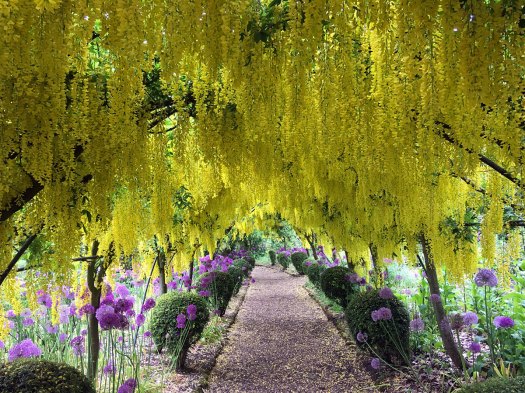
I’m inclined to blame the tulips and spring bulbs for beguiling me in the past. Whether or not their rainbow glory can truly be faulted, I’ve always missed seeing the Dorothy Clive’s laburnum arch in full flower by just a few weeks or so (mere days in 2015). This year, as you see, I’ve been more fortunate.


The garden’s extensive collection of rhododendrons and azaleas together have a longer peak and were still looking fantastic in and around the Quarry Garden. I’m sorry to confess that at one point I snootily considered these flowers garish – too showy – and observed that the form of the plant can be rangy. It’s only by visiting the Dorothy Clive Garden that I have learned to cast my prejudice aside and wholeheartedly embrace the flow of their colour and variety. This trip I even caught myself trying to get an artistic photograph of a rangy one to capture the atmosphere it conveyed – a sure sign that the mighty has fallen.
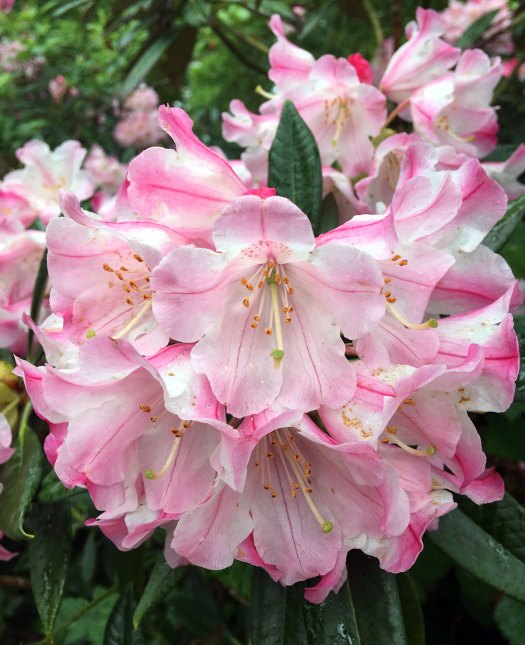
This striped beauty seemed to underline my earlier faults, proving that rhodis can be as ethereally lovely as any plant you’ll find in a shady spot.


An owl by chainsaw artist, Angel Maltby, perched as watchfully as a sleeping owl can over a fairy door, the largest of several dotted around the garden. The garden encourages school visits: other details that might interest curious children include insect hotels that provide shelter for pollinators in the kitchen garden.
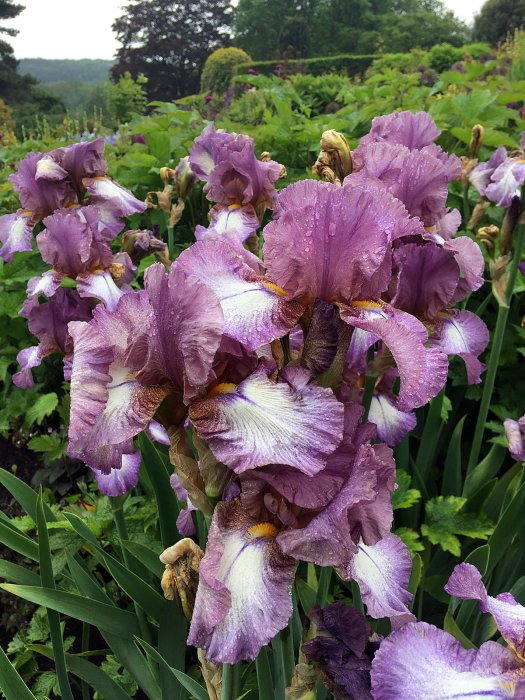
I’ve never had a problem admiring irises and these mauve ones were particularly striking. I’d like to say that the petals have a romantic covering of dew, but it was a dull day with the odd shower.
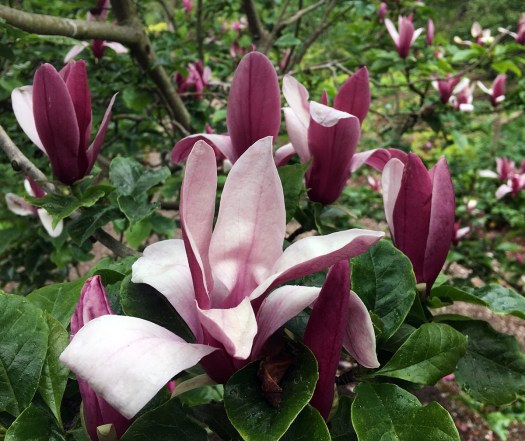
On the way up to the laburnum arch, I passed this magnolia flowering bountifully, the maroon colour on the outside of the petals contrasting beautifully with their lighter insides.


I’ve been wondering if roses are on course to flower earlier this year. Perhaps just a touch if the weather stays fine.
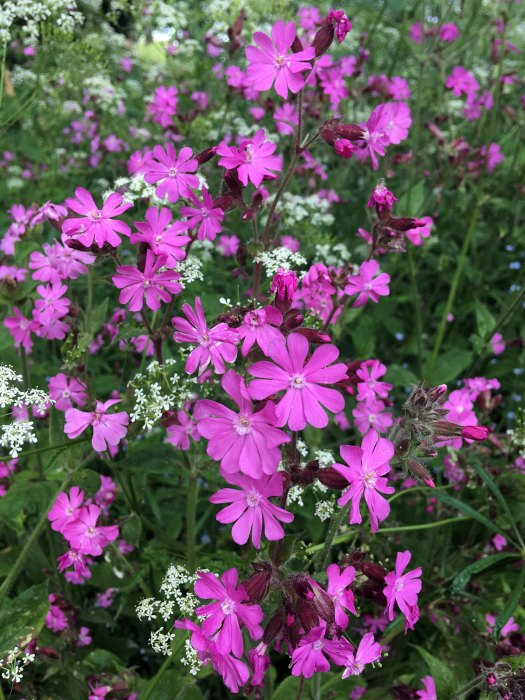
It is always lovely to see wildflowers incorporated so confidently in the planting: Silene dioica (red campion), Anthriscus sylvestris (cow parsley) and Myosotis scorpioides (forget-me-not) together creating a tapestry effect.
The garden is run as a charity, so if you get a chance to visit, you’ll be supporting a good cause. For details of events, opening hours and prices, check out the Dorothy Clive Garden’s website.
 Susan Rushton
Beautiful.
Thank you!
Beautiful
Thank you!
Absolutely beautiful. 😀
Thanks, Cee.
So very, very beautiful!
It always strikes me anew each time I visit that this is a rainbow coloured garden.
I’m ashamed to say that I was born and raised close to the Dorothy Clive Garden and never visited.
I suppose you had different priorities back then. It does make a great excuse to go back and explore your roots. It’s a nice part of the country too.
I grew up just over the border in Cheshire. My parents are still close in south Staffordshire.
An even better excuse!
Laburnum arches in other regions are what almost popularized laburnum here! I do not know where it started, but they were a fad in the mid 1990s. We had to bring laburnum in for some of our clients because we did not grow it. However, laburnum does not do so well here. I really could not understand why we do not stick with wisteria.
People so often want what they can’t have. Laburnum does well here and it’s very striking when it flowers. I was amazed that wisteria is considered weedy in some places I’ve visited, as it is such a classic here – I’d go so far as to say stately, if a plant can be stately – but I suppose extreme vigour can be an issue in warmer climates.
We happen to really like wisteria here, and it does not naturalize. However there are places where vines have escaped into the forest and covered large areas and climbed very high into redwood trees. Fortunately, they do not seem to grow from seed, so as huge as the vines get, they have their limitations.
Even the 2015 shot of the arch is magical. What a glorious place! Have you ever been to the U.S. National Tropical Gardens on Kauai in Hawaii? The laburnum reminds me of the golden shower tree there, which is one of the most glorious trees I’ve ever seen. Showy, yes, but who cares? Also, what you call a magnolia is not the same as the magnolias we have here in Texas, which have thick, shiny dark green leaves and huge waxy flowers with a slight lemony scent. They bloom a little later (late spring-early summer) in the U.S. deep South. I grew up in Northern Ohio and we had the pink magnolias in the spring. If you google images “magnolia” you’ll get both kinds. (Plus lots of references to Chip and Joanna Gaines.)
I’ve never been to Hawaii, but I’ve been lucky enough to see many different types of magnolia in other US states – even a yellow one – and to marvel at the grandiflora flowers. Those ones aren’t quite as successful here as late frosts often damage the flowers but you’ll often find a fine old tree espaliered against a country house wall for protection. The one pictured is a Japanese magnolia which is more often grown here and in the northern states of the US. My sweetheart tells me it is the pink magnolia that blooms before the azaleas in Texas.
Chip and Joanna Gaines were new to me! 🙂
Gorgeous shots!!
I’m glad you liked them!
Beautiful. Thank you for sharing this and brightening an overcast morning for me.
My pleasure.
Lovely flower images (as always), but that laburnum arch is truly extraordinary. How lucky you were with this year’s visit.
Thanks for sharing.
It seems Laburnum arches are like what we used to say about Liverpool buses when I was a student – you wait for ages and then they all turn up together. We actually got a hat trick this year. As well as this one we caught the one at Bodnant, which is longer, more crowded and more uniform, and a smaller one in Happy Valley, Llandudno.
The laburnum arch is simply breathtaking. Generally I’m not a fan of either rhododendrons or azaleas because I think they are a bit dreary after they’ve finished flowering, but your photos make me want to reconsider!
I have sometimes seen them converted into wishing trees later in the year, with colourful ribbons tied on.
A wonderful garden. I created a laburnum tunnel in the 90s after seeing the one at Bodnant but I moved before it got established. They are a wonderful sight.
That must have been another big wrench at the time.