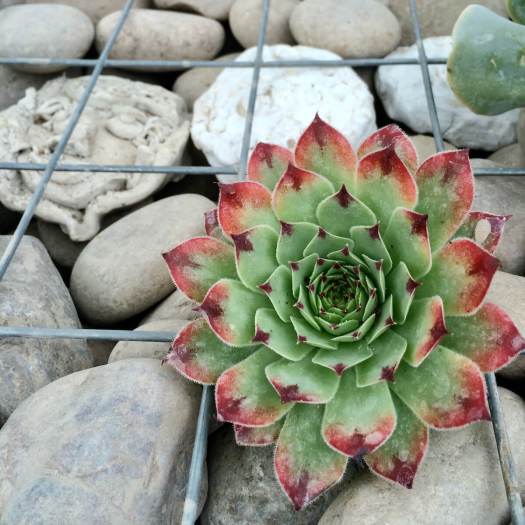
Just a quickie today: I’m bidding farewell to another fine month of squares, with a caged up succulent. I never look at this picture without wondering if the sempervivum is rooted or balanced there.
Thanks as always for being a wonderful host, Becky!
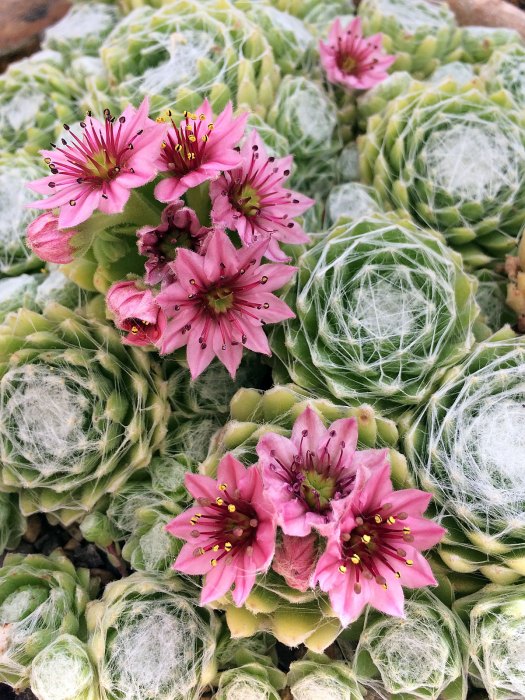
You don’t need me to tell you how the cobweb houseleek (hen-and-chicks, or in botanical terms, Sempervivum arachnoideum subsp. tomentosum) got its folk name. Those with a fear or spiders or a compulsion to dust might find this plant unsettling. If it looks on the creepy side, try to imagine the leaves are playing cat’s cradle.
Sempervivum ‘Lady Kelly’ with one chick growing out sideways from its mother (front, left).
Many people know sempervivum as houseleek, or hen and chicks, which celebrates the plantlets produced as offsets. It is monocarpic which means the original rosette-like plant will reach flowering size after several years’ growth, then after flowering once, will shrivel and die, being succeeded by its chicks of various ages and any seedlings.
Sempervivum ‘Lady Kelly’ seems to be a rare form. The place where I saw it (Beth Chatto’s nursery) didn’t have any for sale and when I searched for one to buy online, I couldn’t find any source, let alone an equally reputable one.*
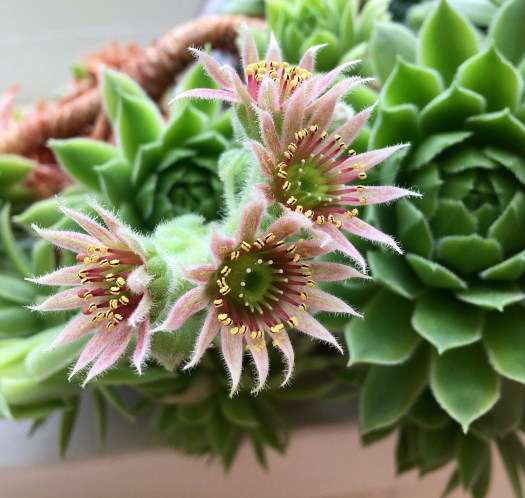
This picture was taken in one of several magnificent plant houses at Kew Gardens that shelter tender or unusual plants. The starry green Sempervivum ciliosum flowers make a lovely contrast with the pink tubular and daisy-shaped flowers scattered across the background. Continue reading “About A Very Gray Cactus and a Flowering Succulent”


 Susan Rushton