Assessing The Beauty Of Hellebore Hybrids

A plant breeder has the unenviable task of deciding which hybrids to keep and which to discard. The nearest a photographer comes to that experience is when we are in a garden exploring a collection of hybrid plants, deciding which forms to capture.
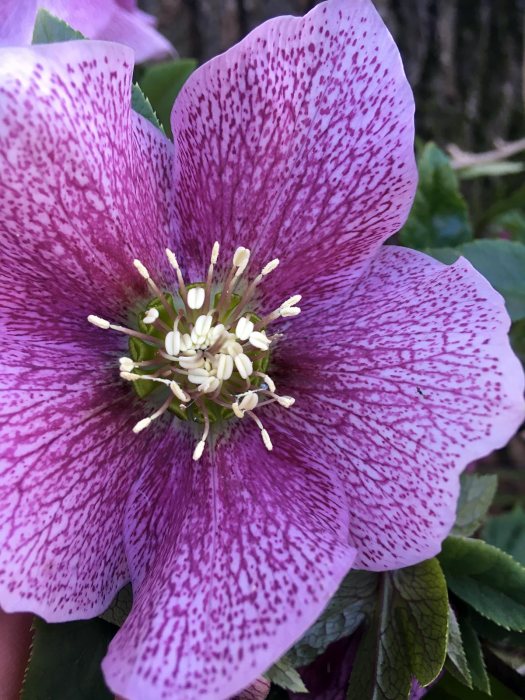
Pink hellebore with an attractive covering of spots

The nodding habit of most hellebore hybrids forces us to bend and balance as we make our deliberations, lifting each flower head and looking inside. As a general rule, the more regular a pattern, the more photogenic the flower if we are aiming for a fresh look rather than artistic decay, but there are exceptions. Continue reading “Assessing The Beauty Of Hellebore Hybrids”

Flowering Orchid: Calanthe William Murray gx

Pink and white orchid: Calanthe William Murray gx

RHS Garden Wisley has a wonderful collection of deciduous Calanthe orchids in flower now in the Glasshouse. This plant was labelled Calanthe William Murray gx. Its upper petals are white with pink bottom lips and a central section shaped like a nose.

There are two subgenera of Calanthe. Preptanthe ones like this are winter-deciduous orchids that die back to peculiar structures called pseudobulbs. Hairy flowering stems appear from near their base and bear a cascade of flowers that weigh the stems down into a graceful arc. Continue reading “Flowering Orchid: Calanthe William Murray gx”

Green Flowers: Hellebores

Helleborus argutifolius has pale green flowers
Helleborus argutifolius

Green flowers are not always as subtle as they might appear – some of them are very striking. Today I’m sharing pictures of some of my favourite green hellebores.

Helleborus argutifolius produces one sturdy stem thickly clustered with flowers and buds a few shades lighter than the darker green leaves, and with golden stamens. The flowers persist for weeks or even months as with all hellebores, eventually forming equally striking seed heads, pollinators permitting. Like Helleborus foetidus (below) this is widely grown in the UK and can be found in many winter gardens.

Helleborus foetidus with dark foliage
Helleborus foetidus

This particular Helleborus foetidus has dark, purple tinged foliage and pretty purple lines around the edges of the petals (or sepals). At a guess, it is part of the Wester Flisk group. H. foetidus is an architectural plant, not because of its height, but because of the stems of elegant, tiered buds that hang like bells above deep, palmate foliage. Continue reading “Green Flowers: Hellebores”

Flowers with backlight effect

Pink daisy flowers made translucent by sunlight

Pink flowers – possibly some form of echinacea – tumbling over each other as if to watch something. They’re at a concert and the ornamental grass is performing on stage, perhaps, or at a football match. An exciting one.

But we know that’s just fancy. Unlike us, the flowers don’t need a reason to be like this, they simply respond at a cellular lever to the sunlight, the soil and whatever moisture they can seek out. Continue reading “Flowers with backlight effect”

January Squares: Light Pink Roses

Cluster of pale pink, single rambler rose

Becky at The Life Of B is hosting a new challenge throughout January with the topic of light, or any word ending in light. The main picture has to be square. I don’t find it easy to crop square, unless the picture was originally taken that way (relatively few are), but it’s good to be challenged.

So why this picture? Well, the roses are the lightest shade of pink; the flowers seem like tiny satellite* dishes, catching and reflecting sunlight, and I’m claiming they make a delightful sight.

Continue reading “January Squares: Light Pink Roses”