I hope you’ll find it in your heart to forgive me if I start with a digression.
While I welcome the Royal Horticulture Society spreading its presence in the North of England, I wonder if I am alone in seeing signs of failure to understand and fully celebrate life in the north, especially when I visit the young, still-developing RHS Bridgewater.
Perhaps the RHS’s powers-that-be are too far away or too used to a life of plenty to appreciate the creativity and fun in us – our type of fullness. An old Punch cartoon showing a BBC documentary film crew on location in the north comes to mind (even with the watermark you’ll get the gist).
I experienced the feeling again, walking through the tasteful Ginnel Garden at RHS Tatton Park Flower Show shortly after marvelling at some of the ‘ordinary’ terraced house, pavement and small space gardens in Hebden Bridge, a Market Town in the Upper Calder Valley, West Yorkshire.
Ginnel gardens are designed to spruce up the long, slender (perhaps originally cobbled) passageways between traditional rows of housing built back to back.
We can’t expect back alley gardens to be exactly the same as the front gardens of terraced houses I’m illustrating here, but there are many similarities, the overriding one being that owners’ spaces butt up against each other and at the notional join, everything changes.
If you want to fully explore the contrast I’m highlighting, you’ll need to click to visit the official pictures of the Ginnel Garden from the show (allow a second or two to load).

While the Ginnel Garden was a fine thing, and I can imagine it precisely fitting the brief for a RHS show, it lacks the spirit of the more interesting gardens, communal or otherwise, that I’ve seen in the north. You may have spotted the claim that ‘everything in the garden is repurposed from fly-tipped rubbish’.
I’ll grant you there was a pallet – though not battered or broken in any way – but most of the items look like they cost a pretty penny and most of them match. If you’re telling me this is what Londoners (or Mancunians) fly tip, I’ll suggest you can anticipate a scuffle between rival volunteer removal services if these were fly-tipped in most parts of Lancashire or Yorkshire. I can easily imagine a start-up garden centre blossoming from fly-tipped junk of this calibre.
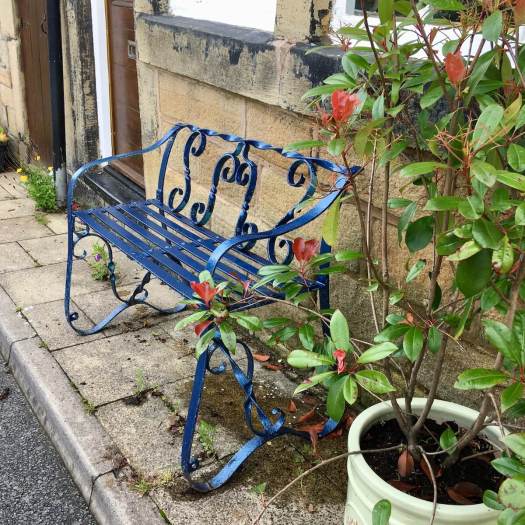
But back to my topic. Until now, I’ve been trusting to your indulgence by writing about something other than what I’ve been illustrating. Let’s go back and look at the real thing and see how it compares.
These small-space gardens are all from Hebden Bridge which covers the steep sides of a valley and the original settlement perched above it, Heptonstall. I’ve already shared a few pictures from my visit in a recent post and promised to follow up with more.
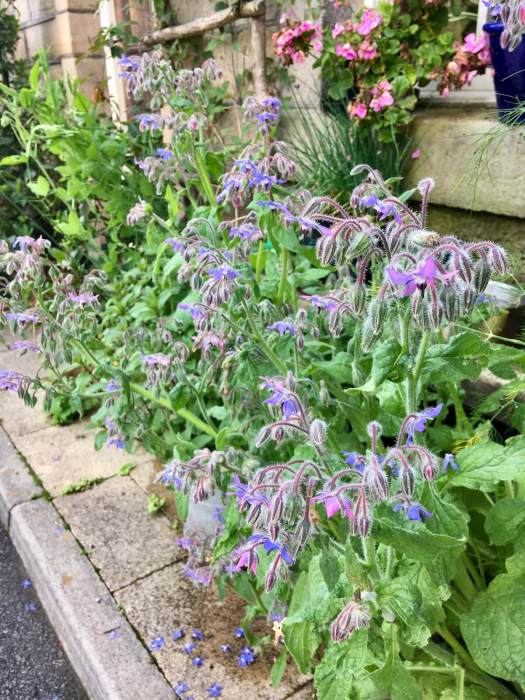
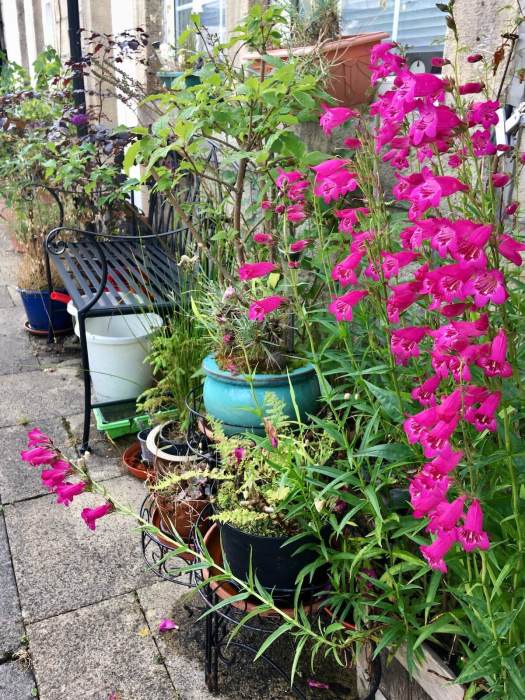
Container gardens add cheer to narrow pavements outside terraced houses where the doors open directly on to the street.
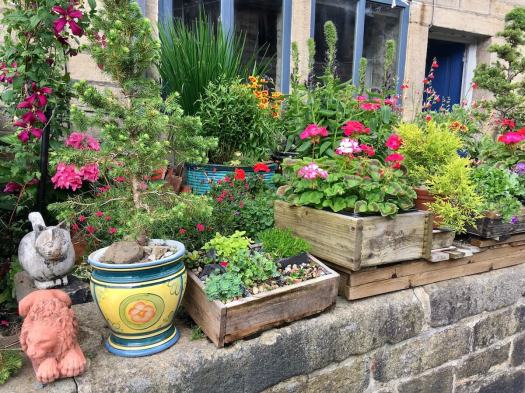
Many spaces illustrate a term Eliza Waters recently introduced me to – cramscaping – the idea of tightly packing plants together so you don’t have to weed, except in this case it’s because there isn’t much room, you love plants and want to lead an outdoor life.
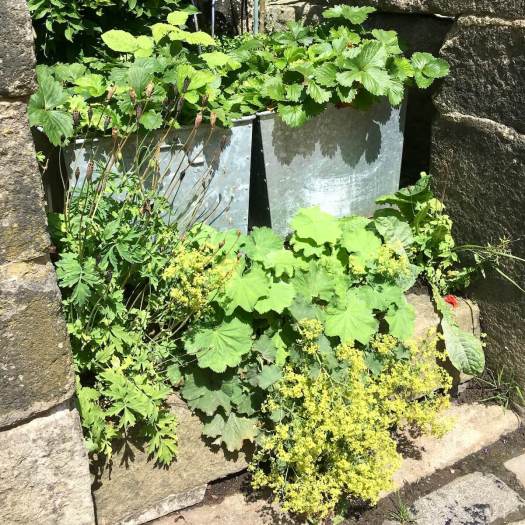
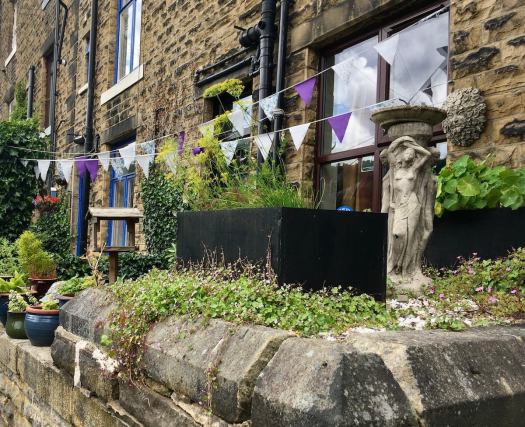
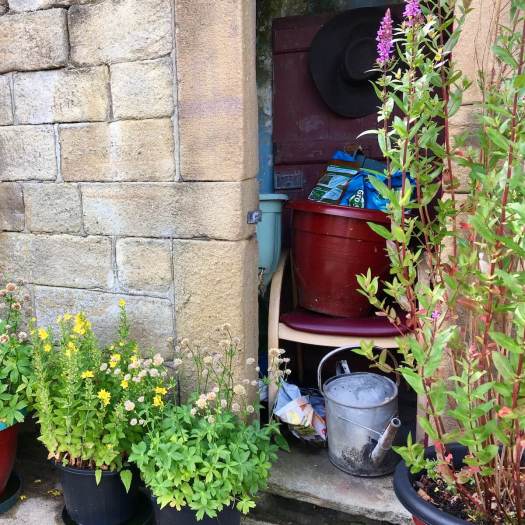
Gaps in the stone walls are filled with plants or turned into tiny sheds.
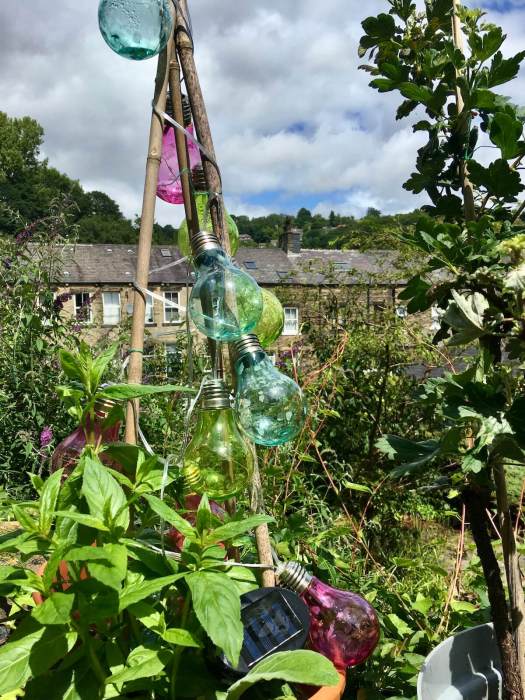
A lightbulb wigwam is the nearest England generally comes to a bottle tree, even in a place renowned for its artistic community.
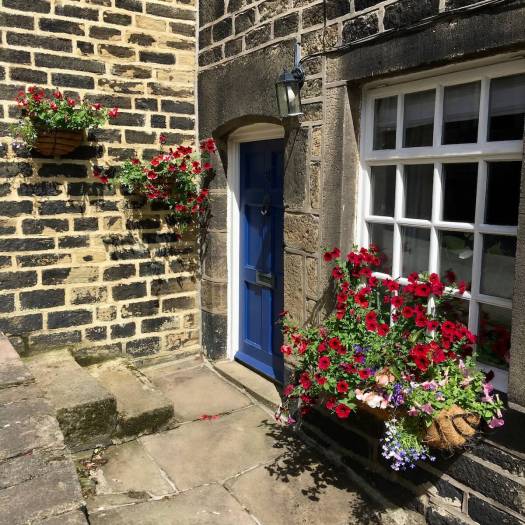
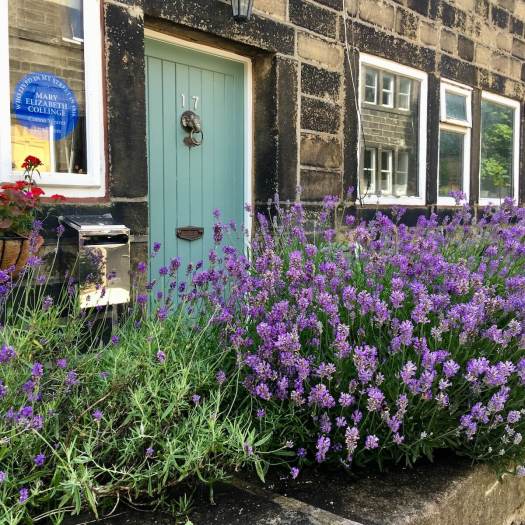
I loved seeing the blue plaques in windows left over from a 2016 project where townspeople researched who lived in their street 100 years ago. It was inspired by the National Register of Historic Places Blue Plaques that commemorate places associated with well-known people, except that these plaques celebrate the lives of townsfolk such as Mary Elizabeth Collinge, a Cotton Weaver.
Apparently, even in 1916 during wartime this was a colourful market town ‘with circus troupes, Russian students and travelling sales people passing through.’
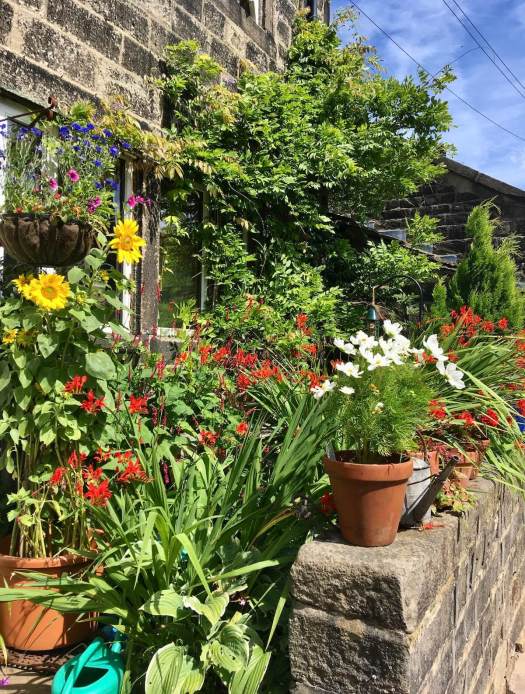
Wherever the eye fell in 2023 was a happy mix of decoration and utility: hanging baskets, beed door curtains, stone walls lined with pots, garden art, watering devices and garden tools. While each garden was individual, the sense of community was overwhelming.
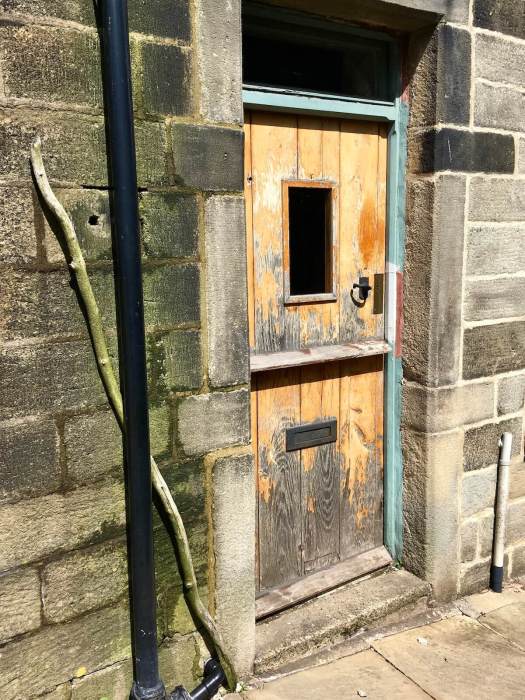
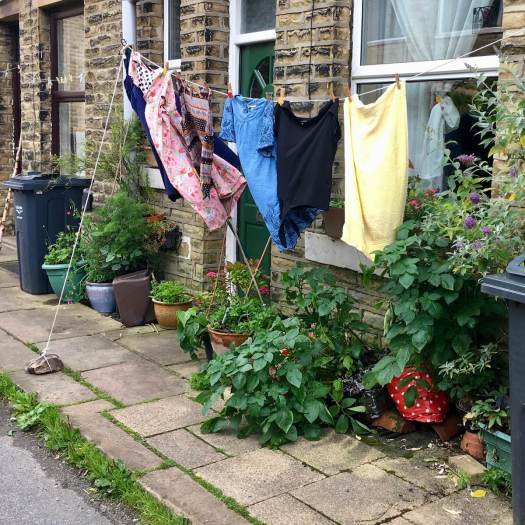
In doing what they can to attract a more diverse ecosystem supported by plants, householders don’t worry too much if a few plants wrestle a living in the pavement, at the foot of a drainpipe or along the edge of the road.
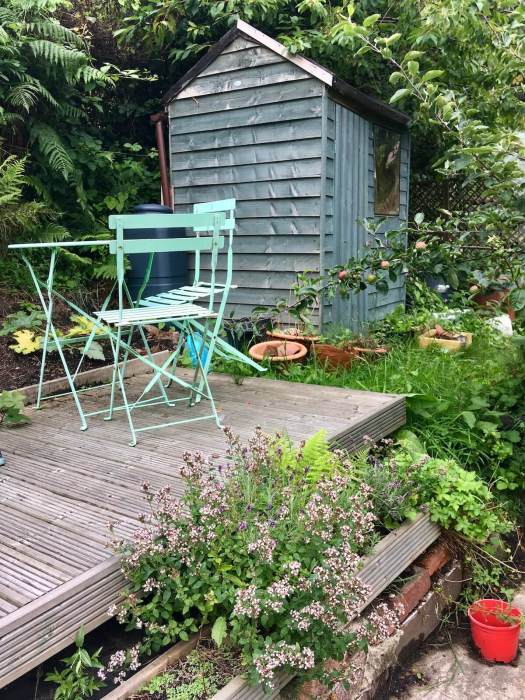
I thought I’d share a few glimpses of several intensively used allotments around the town where gardeners had more room to plant, but the simple enjoyment and make-do character remained.
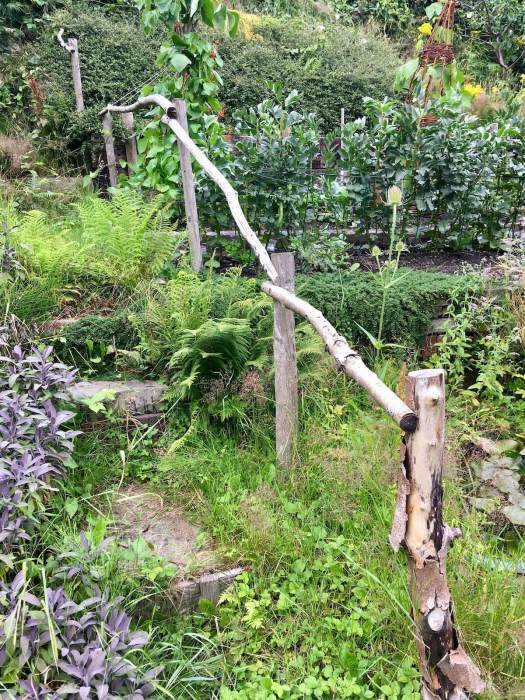
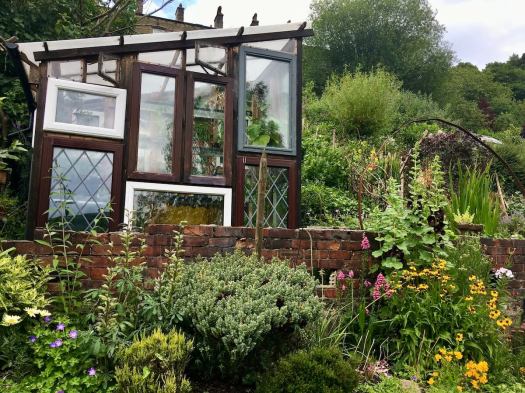
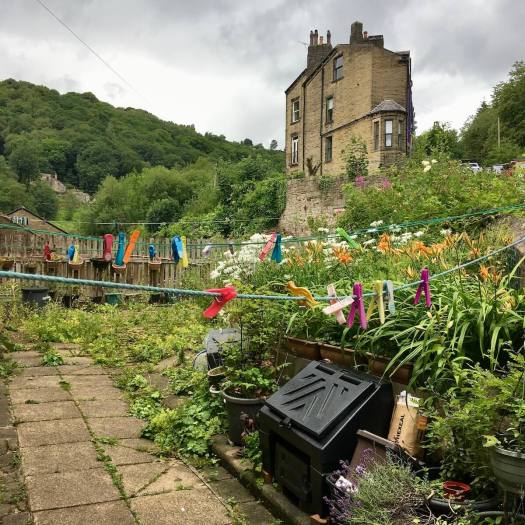
Even an empty washing line was decorative.
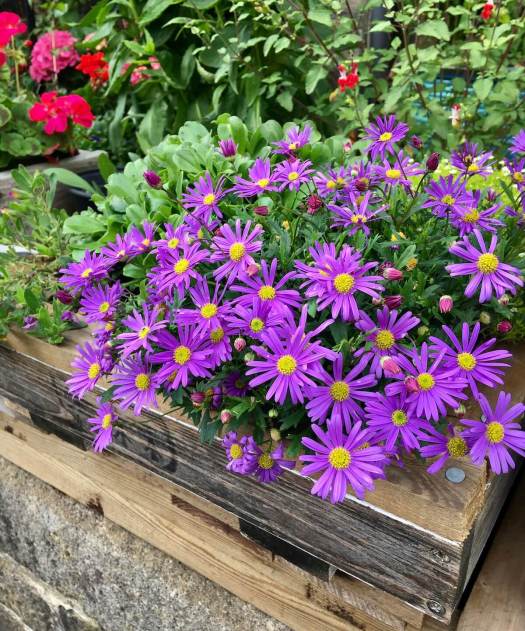
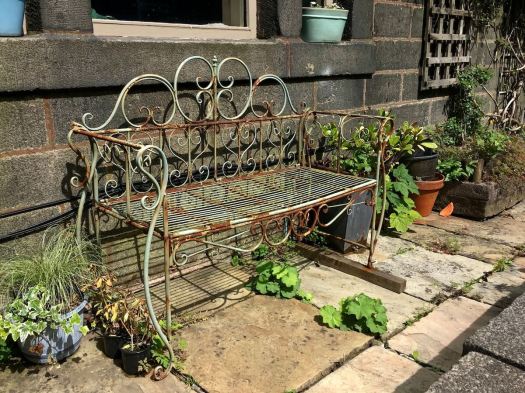
Whether handmade or recycled, I saw many very desirable containers in wood, stone or metal, filled with flowering plants, climbers, shrubs and trees.
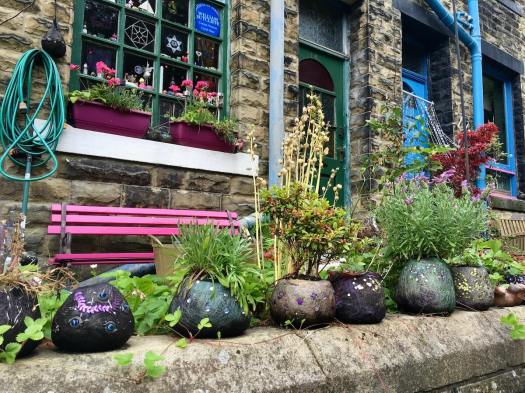
While the people living in Hebden Bridge and Heptonstall are wealthier than average for the north, the value in their garden accessories is not just monetary. Containers and other objects made or collected over a lifetime show signs of being well loved, in the way only humans can love an antique teapot, a weathered statue or a concrete chicken…
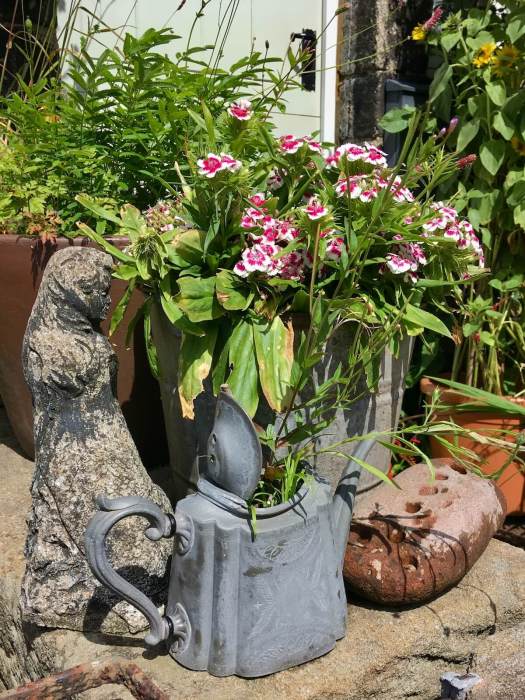
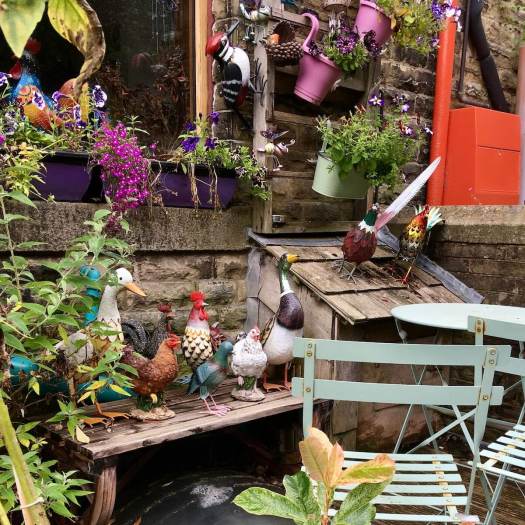
things a gardener might proudly present to their neighbours and passers-by, beak first.
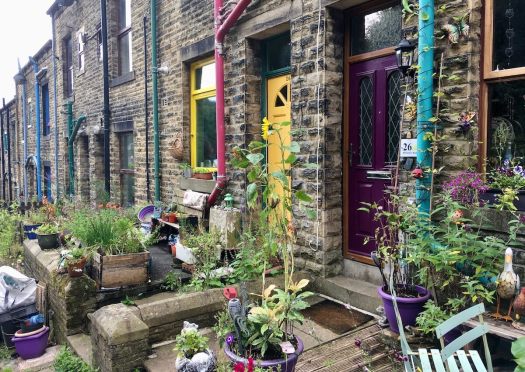
Bold, mis-matched colours on drainpipes, windows and doors give the sense of neighbours playing along. I’m idly imagining the sense of freedom and quirky fellowship someone enjoys when thinking, ‘next door has a yellow door and black sills, next-door-but-one’s drainpipe is turquoise, so we’ll go with hunter green pipework and an orange door.’
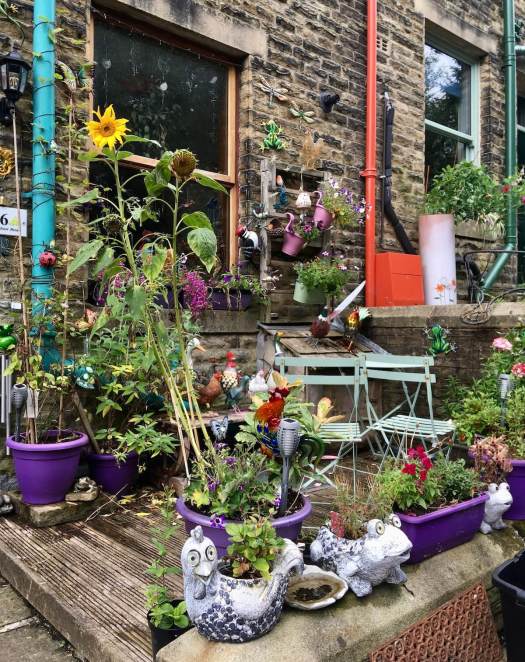
So next time the RHS sets out to educate northerners about small space gardens, I suggest they nip up to Hebden Bridge first and perhaps see if they can arrange a week’s loan of some of the items in use here.
I’m sure enough of these creative, warm-hearted people would say, ‘OK, just this once, but be sure to bring ’em back safely!’
 Susan Rushton
It’s what you do with what you got! I love the partnership of flower and stone, the age of everything — pots, homes, watering cans — that lends a story to it all. I hope those people “up themselves” (a new and useful phrase for me) take heed!
You’re right – these are making the very most of what they’ve got and my hat is off to them.