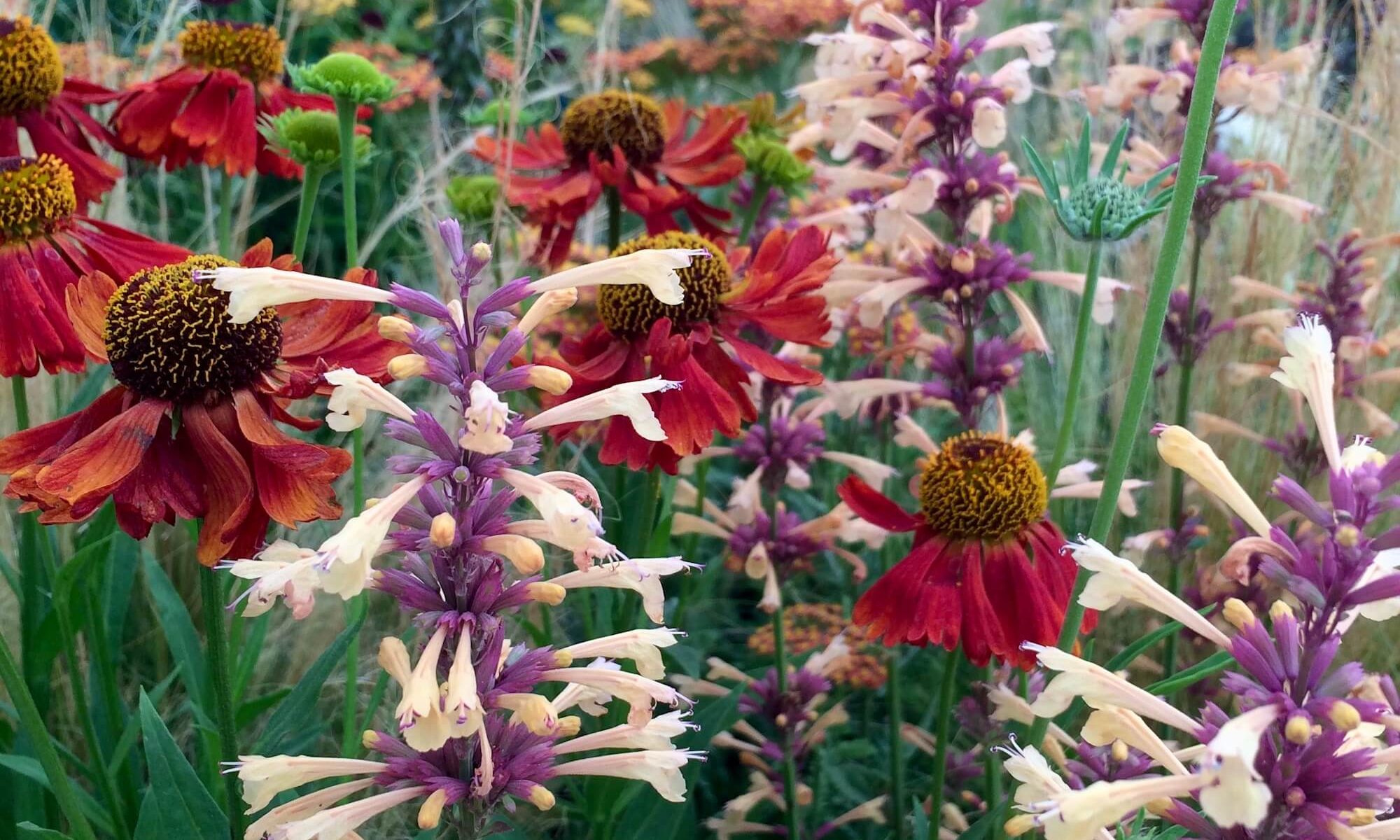

While not a native tree, characterful flowers, leaves and seeds have made the horse chestnut tree so wildly grown that it is (or should be) part of every British childhood. Tough, spiky cases with an inner layer of padding protect large, polished chestnut-coloured seeds (conkers) while they form.
One of my memories of Autumn ’22 will be standing under the canopy of the biggest horse chestnut tree in Bold Venture Park to see if any fine conkers were left in the leaf litter underneath, a habit that dies hard. Better than that, I soon discovered, turn and turn about, conkers tippling their balance from unreadiness to ripeness in a decisive instant were slowly, heavily, falling around me.
Such a normal fact of nature, yet not something we often stop to experience. With a breeze rocking the branches, a chestnut or two landed every minute or so. The tree is on a slope and I watched the conkers thud, bounce and roll.
Their hardened cases are plant versions of the mean-looking spiked balls medieval knights dangled from sticks. Making an effort to discount the chance of one striking me on the head , I found their languid, absent-minded dropping from the tree oddly soothing. More than I had expected were falling without their shells; some fell already bitten. Squirrels’ work.
I picked out two or three to bring home although my conkers-playing days may well be over.

For any readers who have missed out on the game of conkers, here’s how you do it:
Every expert has a different method of selecting and hardening the seeds. Never a conkers extremist, I look for big, round, unmarked ones and just leave them to shrivel. Next, you pierce their centres and hang each one on a knotted string.
The Woodland Trust explains how to ‘check for duds’ and has a detailed 4-step plan, but all boils down to a phrase hidden in step 3, ‘try and bash it’.
An untried conker is a none-er. On its first victory it becomes a one-er, then a two-er and upwards. Knuckles are rapped almost as often as conkers, if my memory holds.
Some local versions of the game decree that when you split a conker, you get a point for the win and inherit all the loser’s victories. Aeschylean rules, giving a nod to the botanical name, Aesculus hippocastanum, add an extra challenge. You lose a point after every three wins (each trilogy of wins) as a reminder that tragedy is unfair, that we should not fall prey to hubris and we ought to have respect for the conquered.*
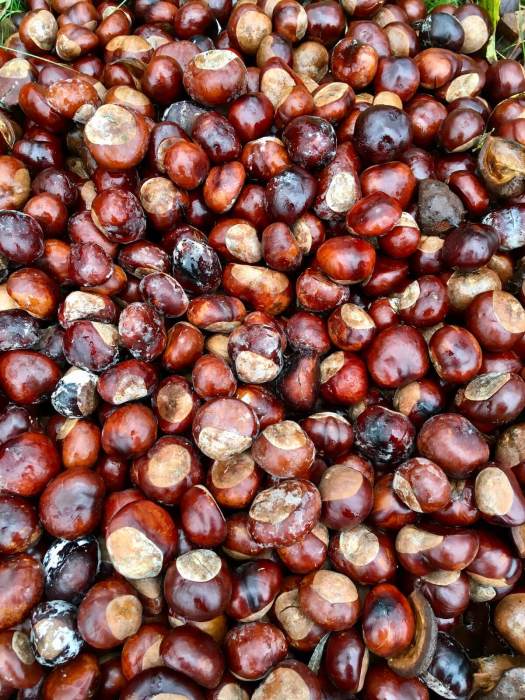
My pictures, shared for Becky’s WalkingSquares, show a mystery trove I found a couple of days ago near a children’s playground while walking up to Blacksnape.
It’s another chance to wonder. Who would collect so many and abandon them, some still in their shells? A purist? Imagine the excellence of the ones they selected.
* Alright, I confess – I made up the Aeschylean rules.
 Susan Rushton
Ok, I thought that was a complicated game.
At least I ‘fessed up.
I see a chestnut and it’s NYC Central Park in the snow, charcoal roasting chestnuts in the air.
Oh… that sounds wonderful. I have been to the park, but never in the snow. I love sweet chestnuts too, but these are not the edible kind. They are not even good for horses to eat, as you might think from their folk name. If they had been the edible ones, I’d have packed my pockets full!
Oh, tee-hee! You had me going with Aeschylean rules. Somehow, it seemed so right. Marvelous piece. Never heard the word “conkers” until I started reading British novels. Chestnut trees are not common in Maine—dang it all!—which means I never had the pleasure of playing conkers. I imagine that some of the games became quite heated, especially when a conker was split.
A bit tricky to persuade school kids round here to lose a point for hubris. Nor at Eton, evidently… if only we could think our politicians had learned the lessons of Aeschylean conkers.
It is chastening to see a nine-er smashed without heed for its glorious victories, but the players do get excitable because of protests and squeals caused by hitting your opponent’s hands rather than their conker.
Lovely photographs. As a I child I spent many happy hours on Wimbledon Common chucking branches up to knock the conkers down. Some years ago a school banned the game under Health and Safety regulations. I forget where, and don’t know if it still applies anywhere.
Jude (below) suggests it is generally outlawed at school. I can imagine the odd kid coming a cropper from throwing branches into the trees too. How we all survived…
I remember playing conkers with my brothers and mates at school. Banned now of course, because of those bruised knuckles. How does one prepare for life without the odd bruise or scraped knee or bump on the head from a conker falling. (Great photos)
Did you ever play with clackers? They were round, hard balls on either end of a string and you clacked them in succession above and below your hand. Those really hurt.
I remember those, but never played with them. I would have been useless. Could barely operate a yo-yo.
So far as I remember, you just got hold and moved your hand to and fro and they pretty much did themselves. The trouble was stopping – they were breaking people’s wrists.
That’s really nuts.
A lottery prize for a squirrel.
OMGosh! Clackers, Yes they did hurt if you got it wrong. Showing our age there lol.
We could have been late adopters 🙂
Hahaha, of course 😉
Does anyone play conkers any more? I watch children walking past them on the ground these days, something my childhood friends would never have done. We loved playing or at least collecting them as much as the squirrels!
We’d have pounced on them too. I went back a few days later, half-expecting them to be gone, but most were still there. Not even birds or squirrels had taken them. You’d think someone would have taken them for something. I have an artist friend who paints buckeyes, which are similar.
It’s been a bumper year for conkers, and I can’t resist collecting them when they’re glossy, and with all those subtle patterns. I can’t remember if I actually played conkers – I think it might have been a boy thing. Like Jude, I could barely operate a yo-yo. And as for two-balls … no chance.
They do have nice, streaky patterns. I think you’d remember if you’d played them. I have a strong memory of pulling my fingers straight down on the string to still and centre them and of being more keen to bash my opponent’s than offer mine up for destruction. I can’t imagine I was often victorious.
But you battled away anyway!
Had to go study up on conkers, had never heard of them. http://projectbritain.com/conkers.html I found myself clenching my jaw just reading about those cracking blows. Beautifully written post, thank you!
” Oddly oddly onker my first conker”? Perhaps that’s where I’ve been going wrong.
I always wondered how conkers was played, thanks for enlightening me!
There are nuances The Woodland Trust hasn’t mentioned. In a comment above, Sam, has linked to a site that outlines more rules.
They are so beautifully tactile. I thought this was an entry for Jude’s Textures.
I suppose it could have been. I am planning one, all being well.
😁💖