Rosa mutabilis is best known for the way each flower changes colours, often over a single day.

The petals have a luminous, sheeny quality.


Most descriptions say that the flowers open buttery-yellow, then turn via apricot-copper to pink, deepening to crimson.
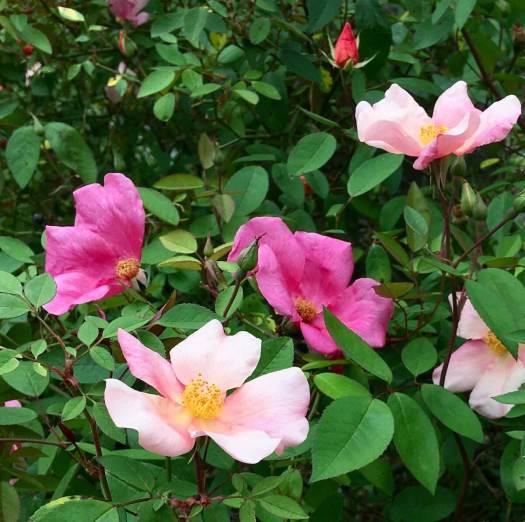
Crimson is perhaps a step too far, but my pictures show that orange-red buds should be thrown in the mix.
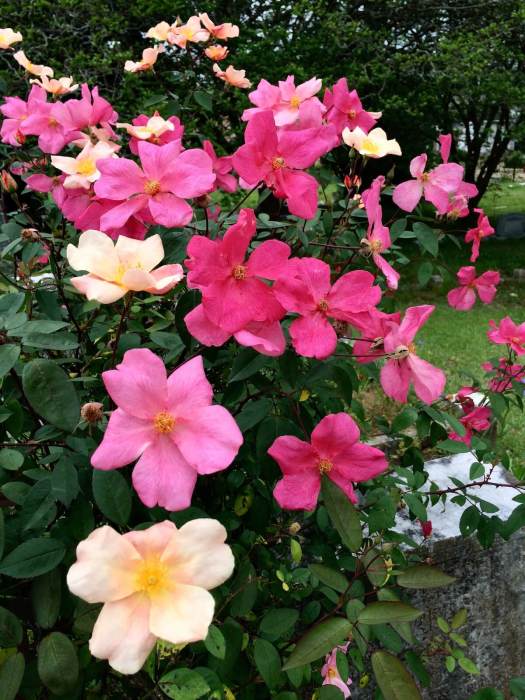
While the rose is clearly true to its Latin name, ‘mutabilis’, which means ‘changeable’, the individual flowers may look less like the butterflies of its folk name.
Almost all shrub roses move even in the gentlest wind. While the heaviest doubles have a ponderous, rolling bounce; lighter, single-flowered roses like these often seem to flutter on their stems. Rosa mutabilis has slender, wiry stems that hold each flower alone, rather than in clusters, at different angles over the plant. Add in the various colours and you have a butterfly effect.


Rosa mutabilis has an airy, open habit that allows it to beautifully combine with other flowers, which have space to grow around and even within the frame of the plant, like a real-life flower arrangement.
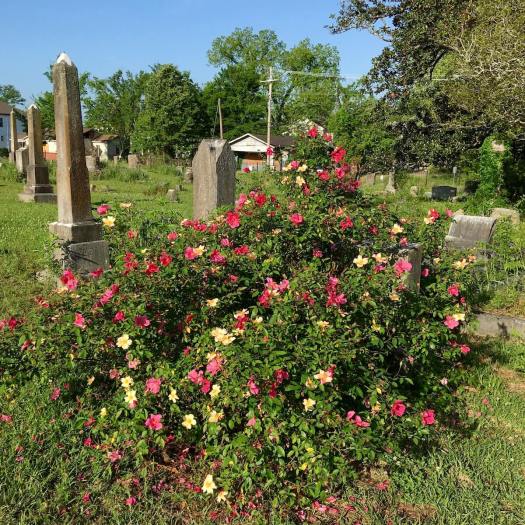
It really prefers a warmer climate than the UK (although it feels ironic to write that on the day when Britain’s temperature tops 40°C for the first time and Network Rail has a ‘Do not travel’ warning in place). I’ve often seen Rosa mutabilis in Mississippi where it makes a fine, medium-large shrub and produces sweetly scented flowers in flushes. Our friend Robert might add, ‘Rather too large’, as it is swamping out his irises. Several of these pictures were taken in Greenwood Cemetery, Jackson, MS.
It is less often grown in the UK where it tends to be smaller, although in a sunny, sheltered spot, it can do very well. A couple of years ago, we just missed seeing it in full flower, trained as a climber against a beautiful old stone building at Cothay Manor. Even covered in spent flowers, it was an impressive plant – well over 2m (6 ft 6) high and wide.
Synonyms include Rosa chinensis ‘Mutabilis’ and Rosa ‘Tipo Ideale’.
This is part of an occasional series of posts about unusual roses.
 Susan Rushton
What a variable flower! Love the way it changes color. Hope the hot weather passes soon.
It did. In the northwest we are back to very reasonable temperatures with misty rain.
Sounds lovely!
These bright colourful flowers made my day. Thank you for sharing, Susan!
I’m very glad to hear that. My pleasure!
Love love your vivid imagination and delightfully rich descriptors Miss Susan! Say hi to your honey and please come back to Fairhope! 😊💕🌸🌿
It’s very sweet of you to say so! We were sorry to have missed you. I enjoyed exploring Fairhope’s village centre and seeing how the kerbside hell strips have been turned to Heaven strips.
Always a day-brightener. You provide both beauty and interesting facts.
Thanks so much!
That is so interesting that it changes colors.
It’s funny how it deepens in colour – you would imagine it would fade, wouldn’t you? I’ve seen several other modern roses that change colours: Rosa ‘Christopher Marlowe’ for example. I saw a striking semi-double recently that opened yellow and turned coral-pink, but I don’t know its name.
Gorgeous roses 😀 😀
Thanks, Cee.
The changing of colors is new to me. It certainly is ironic about the UK temperature, isn’t it? Maybe this variety might make a big-time comeback if the weather “normal” there continues to change. Beautiful flower.
Some roses do change colour, and quite often the buds are a different colour to the flower. The high temperatures quickly abated, but the overall trajectory has surprised even our weather experts.
It’s a beautiful flower and I always love seeing it in Trelissick garden.
Favourite corners and plants in gardens can seem like friends after a few visits.
A rose by any other name…. Always lovely!
Thanks, Jo.
🤗🌹💕
I have ‘Mutabilis’ growing in a pot out the front of our house as a way to keep it under control. What really fascinated me were your cemetery photos – where is it?
It’s Greenwood Cemetery, Jackson, MS. I recently shared some more pictures here.
So beautiful Susan 🙂
I’m glad you liked it.
I’ve heard ‘butterfly’ applied to several flowers, like our native Gaura, but I’ve never heard of a butterfly rose. They’re quite beautiful, and the color changes are delightful.
Some of the older roses have folk names, eg Chestnut rose, Burnet rose, Rosa Mundi. I doubt that many modern ones will get them, although time might prove otherwise.