In Phantastes by George MacDonald, a country maiden warns the hero, Anodos, to shun the Ash and the Alder, but says he can ‘trust the Oak, and the Elm, and the great Beech.’ Sure enough, Anodos meets a Beech tree with a voice ‘like a solution of all musical sounds’ who longs to be a woman. She invites him to cut lengths from her hair, and uses them to create a protective girdle of beech leaves for his magical journey.
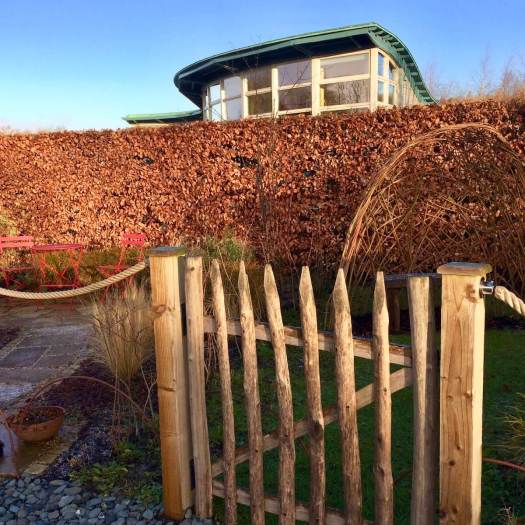
All fantasies have elements of truth. Beech marks our boundaries, provides windbreaks, backdrops and privacy screening for the gardener; food for wildlife; and nesting places for birds.
European Beech (Fagus sylvatica) can live for 250 years or more. Grown as a tree it can reach 45m (148ft). Since Beech clips well, it can be kept at almost any height, making it one of the most popular hedging plants in the world.
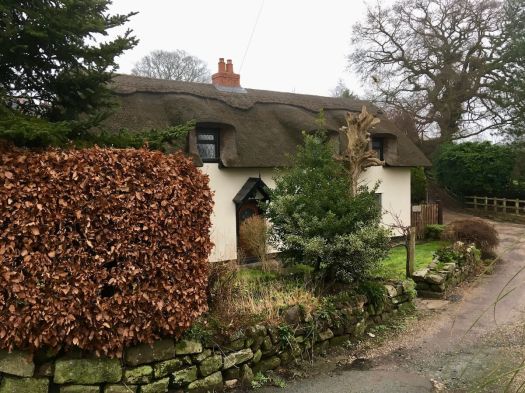
Beech is increasingly used as deciduous topiary, so you may see it clipped in columns, serpentine or wiggly hedges, panels, domes, beehives, cubes, mushroom shapes, balls or even sliced lollypops on a stick.
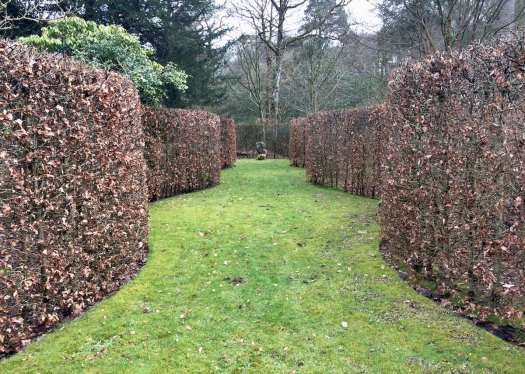
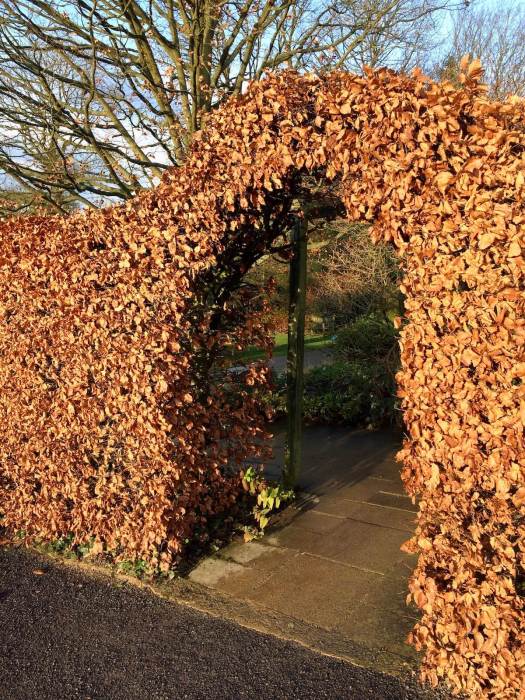
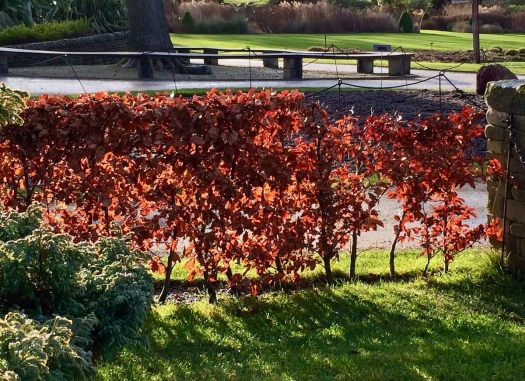
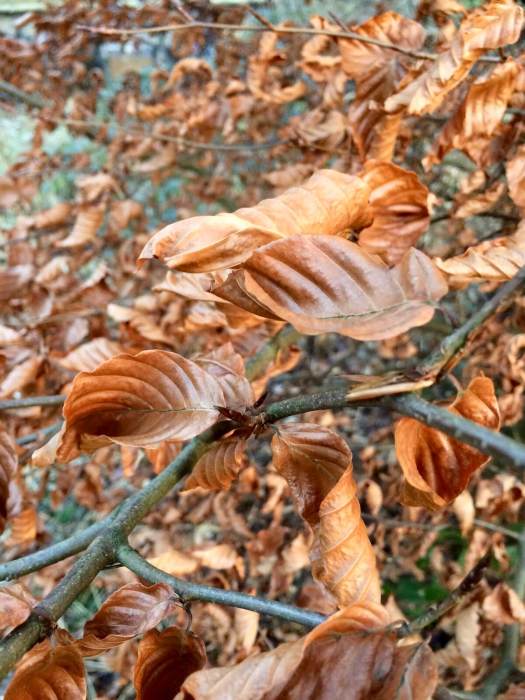
In winter, the plants retain their bronze-brown leaves in patches after they have dried, giving an ethereal, partly transparent look. Eventually the old leaves will give way to fresh spring growth, but until then, their colour livens up winter woods and gardens.
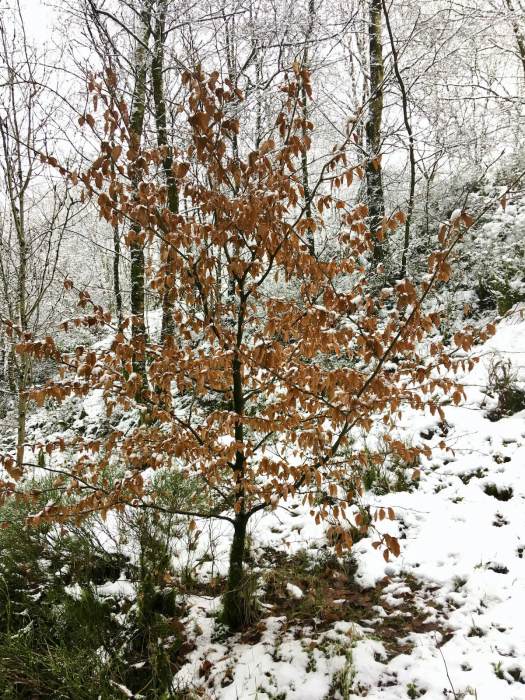
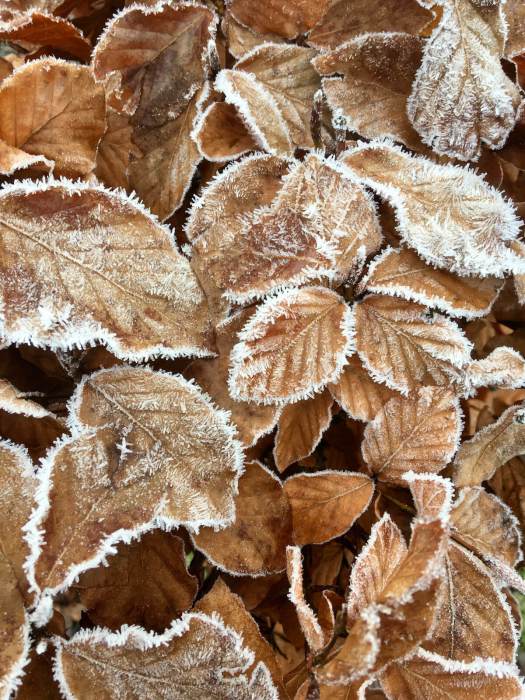
Shared as part of Jude’s Life in Colour: Brown.
 Susan Rushton
I like the trim look and the backlit foliage. Interesting to note that we seldom see clipped beech on this side of the pond. An idea that didn’t catch on, I guess.
We have a history of splitting up our land into tiny parcels – perhaps that is partly where the idea comes form. Beech is often found in our mixed hedgerows. Beech might be a bit slow to take off – I have noticed there seems to be greater desire for instant effects in the US.
Oh, yes, instant gratification is a national problem! 😉
We have too few here in Ontario. Beech – trees and hedges – are a delight. As is your post, Susan.
I wonder if it is a little bit too cold. Hornbeam is recommended for colder spots here.
Maybe it was more costly back then so not as available. There are 100 year old beech trees but not many and the copper beech is more rare.
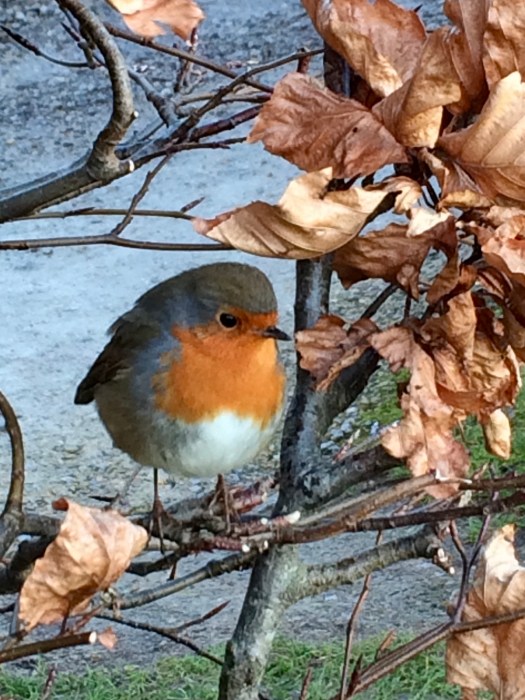
Cutest robin!
It would be nice to have a robin picture like the ones in Harry Potter that are partly alive and can bob around.
Thanks for sharing, Susan.
I never actually thought of ‘Beech’ trees as a hedging plant or in topiary. In my mind, I just think of height.
It is surprising that the same plant that could make a tree would be content to grow as a hedge, but it seems so.
I love the contrast they provide with green hedges, and Jude would love them, because they’re…brown! A very nice shade of 🙂 🙂
I do! Gorgeous golden browns!
I was trying to think of a word for them like evergreen, but everbrown doesn’t work as they start off green
And end up golden 🙂 🙂
Forgot to say, beautiful Robin shot 🙂
The robin is stealing the show, as they always do.
I never would have thought of beech as a clipped hedge, or a topiary. Perhaps our American Beeches aren’t so amenable to that kind of treatment. The tree is native only in east Texas, but there’s a certain orchid that enjoys growing underneath it. I know where there are some wonderful old beech trees; I’ll be sure to look for them in the next month, to see if their leaves still are clinging.
Beech trees are often found in bluebell woods here, which is a similar thing. Even the fallen leaves are decorative, where they do fall. I was amazed to see how thick a layer of beechmast mulch was covering the earth in parts of our local woods recently.
What a lovely tribute to the beech tree / hedge – I love them and they are still clinging onto their leaves in our little woodland. Beautiful photos Susan, especially the frost rimed leaves. Thank you.
My pleasure – thanks for being an excellent host!
Nice copper tone theme.
There’s a lot of life in their colour.
Wonderful post! Yes, even in fantasy there is some realism. Love the picture of the robin. And as Eliza observed, in the U.S. we don’t seem to use beeches for hedges
You have to be patient for the first few years – that might be the drawback.
Or it might be too cold – do you have many beech trees?
We do! They hang on to their butterscotch leaves until spring. I’ll get some pictures soon so that you can see them.
I love those beech trees, the bring some color during winter and the provide places to hide for birds.
I pass a beech hedge several times each week that is loud with birds. I stopped to record them the other day to try to find out what they are.
They are beautiful. I have a hornbeam hedge at the front and a copper beech at the back. Some people seem to hate that they retain their dried leaves, but I love both the look and sound. Lovely post Susan!
Fancy hating the leaves! I think we’re glad for any winter colour we can get round here. Does the hornbeam one keep its leaves?