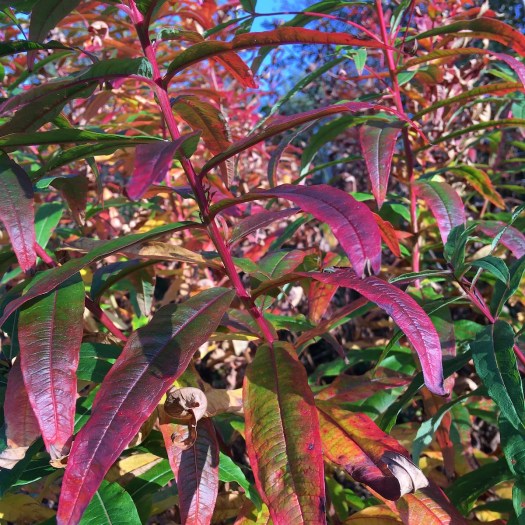
Rosebay willowherb is a colonising weed that appeared in the final picture on my recent post about Darwen moor. While few of us who know it would care to cultivate it, I have seen a white form in some fancy gardens. The pink form, shown here, is eminently overlookable, not because it lacks beauty but because of its ubiquity. It would be impossible to take a countryside walk round here without meeting it along the way.
I found these plants growing wild on the edge of farmland and was struck by how lovely they looked in their autumn colours. Early evening light and a blue sky added a little magic.
The picture looks as if I have clicked on a colour slider and boosted it up as far as it will go. Actually, it is exactly as it came off my iPhone, unedited except for the square crop to please Becky.
 Susan Rushton
The ubiquity of these plants in your area may lead people to slight them, so it’s good that you appreciate their colors. I think fireweed (as it’s generally known over here) is great and wish it grew further south in North America. The latest genus name seems to be Chamaenerion, which is how it started out:
https://en.wikipedia.org/wiki/Chamaenerion
Thanks for the correction, Steve. I’ve updated it. Funnily enough, I think of it as Epilobium.
I think Epilobium is the name I first came across after I photographed fireweed in Alberta and Montana in 2017. It’s hard to keep up with botanists in recent years, given all the changes that have resulted from genetic analysis.
It does look lovely.
We’ve been forced to look for beauty in wild plants this year and I am grateful for that part of things.
A great shot and gorgeous colours – I never thought Rosebay willowherb foliage could look so good 🙂
It is surprising. Steve, above, knows it as fireweed. I expect that means it is one of the first to come back after a fire, but the foliage looks quite fiery here too.
Very unique and beautiful!
It’s a pity the autumn colours are so fleeting.
Yes, fleeting…
Interesting colours, I don’t think I’ve ever seen it looking like this.
I was surprised. It’s another one of those I’ve noticed more this year.
The magenta colour is lovely!
It wanted to go out in a blaze of glory.
Beautiful!
Thanks, Eliza.
very pleased indeed, and like Jude not sure I have ever seen it looking like this before. I had to look it up to check it was the plant I thought it was!!
as in checking to see it in its summer plumage!
It’s not how we imagine it, that’s for sure.
I was trying to think of any other plant that displays that vibrant magenta in my area, and the only one I could come up with is pokeweed. I did smile to see the specific epithet, angustifolium. I recently learned that a variation of the word applies to one of our sunflower species (Helianthus angustifolius) and that it means ‘narrow leaved.’ Do you know why one suffix is -ium and the other is -ius?
I might have been able to hazard a guess towards the end of my schooldays but haven’t a clue now. But I found this:
https://www.thoughtco.com/foliage-words-meaning-of-leaf-names-117905
What an interesting and useful page!
Eminently overlookable, eh? There’s a distinction! It really seems that one would get third-degree burns by touching this — that’s quite a glow. The photo is a lovely close-up of autumn.
It burns itself out quickly once it gets to this point. Normally it is plain green.
What a great splash of color!
We can’t rival your colours, need I say?
😉
A stunning picture and interesting post
Thank you!
You’re very welcome.