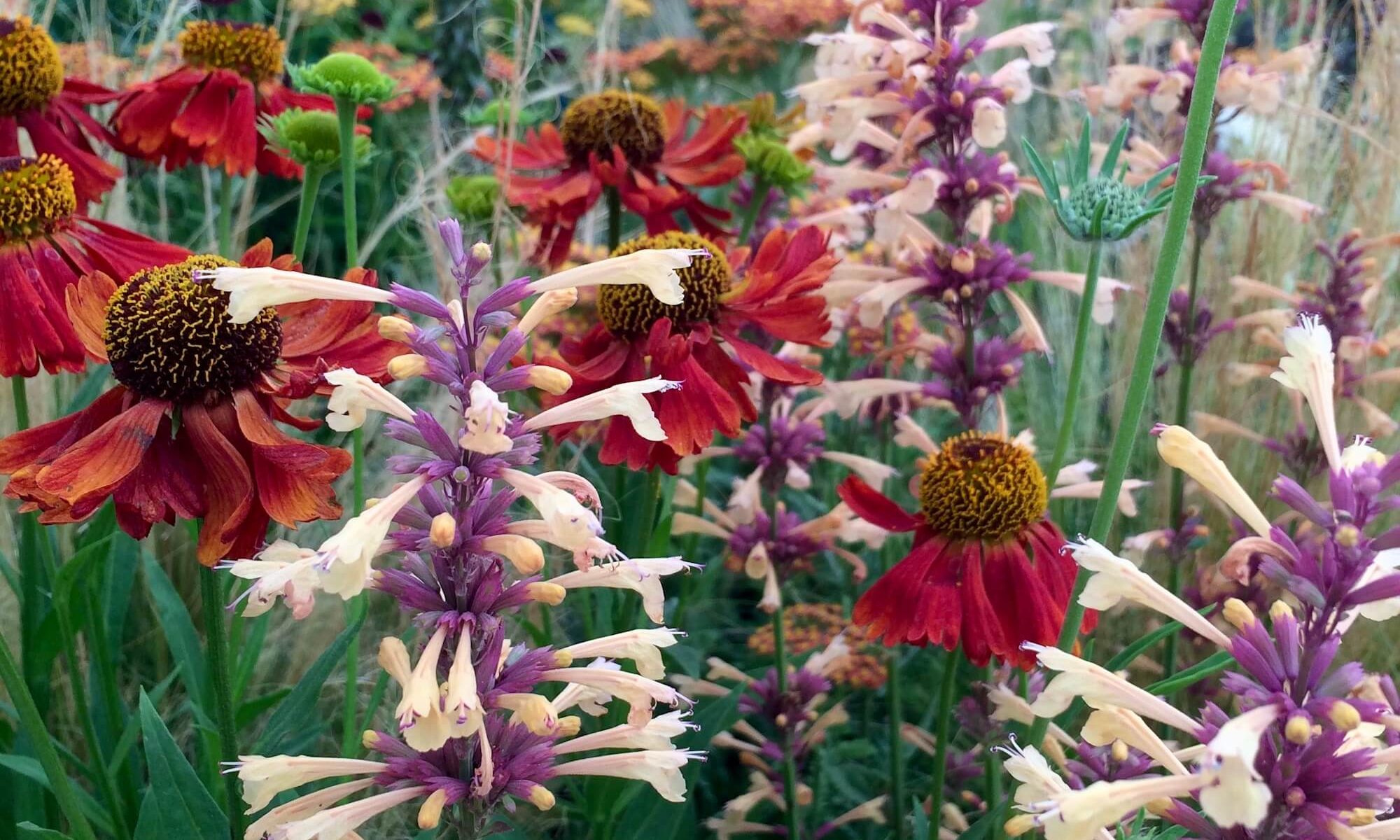

When I first started working with roses and discovered I was going to need to distinguish between 30 or 40 pinks and know their names, I resorted to flash cards: the kind young children use to learn words. In no time at all I was well on the way to a lifetime of floral nitpicking. Is a the shape of a double flowered rose technically a shallow cup, recurved, a pompon or a chalice? That kind of thing.
So I often notice when people mistake a peony or a camellia for a rose, even if I’d have to concede that the colours and forms of their flowers can be essentially the same.
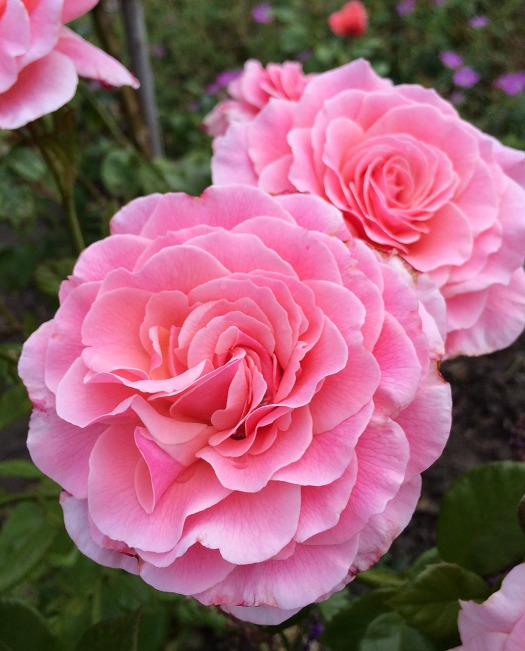
I wish I could get the colours even more similar to better illustrate my point, but that’s just me nitpicking again, isn’t it?

So there you have it. Variations on a theme. All glorious, to my eyes, each with their own particular character: with perkier or more demure petals; with equal, decreasing or ruffle-style petal lengths; with smooth petal edges or wriggly ones.

If you’re not 100% sure which is which, you’re in good company. I’ve seen a cut rose mistaken for a peony in several of Britain’s leading magazines, which I’ll not name, to spare their blushes.
An easy way to tell peonies, camellias and roses apart is by their leaves. Peonies are the easiest to distinguish: they have elegant and deeply lobed, compound leaves, rather like spread fingers.

Camellias have the simplest leaf form of all: the classic, single, oval leaf shape, tapering to a point. They are thicker than a rose’s leaves and are arranged alternatively on the stem, rather than opposite each other, as roses’ leaves are. Camellia leaves often feel waxy or glossy and they are thick, almost leathery.

Rose leaves are thinner and more delicate. Usually there are five leaflets in each group of rose leaves, but you can also find roses with three, seven, nine or eleven leaflets per group:
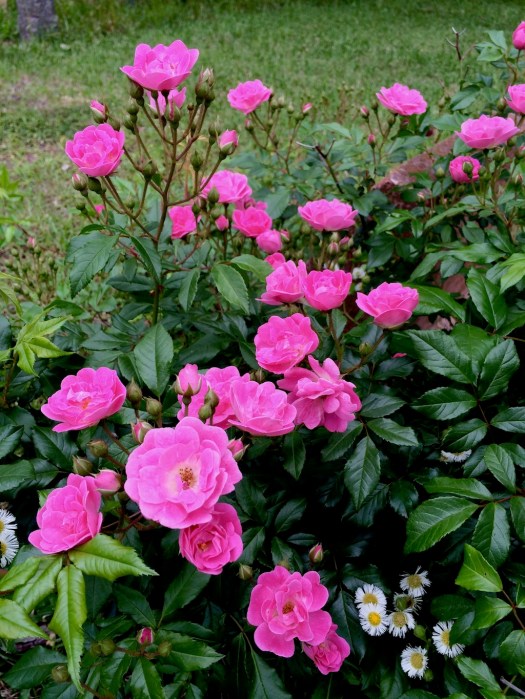
If you have a closed bud before you, peony buds are plump and round; rose buds taper into pointed, sometimes feathery tips; and camellia buds are oval. Hope this helps!
§
If you love one or more of these classic flowers, and want to read more about them, choose from the following:
 Susan Rushton
Superb post; I’m sure they all “smell as sweet”
We’ll imagine they do – much better that way!
Camellias are my favorite spring flower. They remind me of Easter. Beautiful photos
I like to see the sasanquas too in the autumn / early winter.
I agree with you these are glorious! Peony and rose are my two favourite flowers. I used to grow camellia when I lived in England but the climate in Ontario, Canada does not do well for them.
I’d be hard pressed to name my favourite flower, but they’d be in my top ten! I’m a bit on the greedy side when it comes to flowers, but they are such joyful things.
Here goes: camellia, rose, peony, rose. Of course it is a lot easier when you can see them in context with their leaves and stems 😉 Great theme for the challenge.
You nailed it. I have seen roses where I’ve done a double-take because they are so peony-like.
The last image could have been a camellia, except for the thorns! You did well with the colours 🙂
Love this post Sue. Phew, I was afraid I was going to be wrong. For me, the leaves helped 😉 Having followed you for a while, I thought you might have set us with four roses LOL
I didn’t think of that!
Oh I’m so excited that we are in the run up to spring! I love all roses but have a place in my heart for Peonies…..this is a glorious post. Thank you so much for the lovely photos. X
My pleasure. I’m glad they promised better days to come.
“A rose by any other name…” may actually be a peony.
Beautiful garden!
Shakespeare didn’t think of that one!
Beautiful blooms, Susan! I guess it takes years to become familiar with the nuances. I’ve noticed the same errors in hort. mags. (many editors are quite young, I’ve noted!).
It’s easy to mistake a camellia in full bloom for a rose from afar, except you soon realise that it’s the wrong time of the year for a rose to be looking quite that good!
It is much easier if you can see the foliage as Jude mentions, but if you don’t know your dandelions from your daffodils, you won’t stand a chance!
True!
I can easily see who is who, but could have made a mistake if I had not ready the title first.
It isn’t difficult when you know your plants and look closely, but it perhaps ought to be. You can see why non-experts might get confused.
That’s what I mean. I am an expert, and would have believed that the rose was a camellia if you had told me so.
Distinguish among 30 or 40 pinks? And know their names? My brain would never recover. And all those terms for shape! Though it all boggles my mind, I know that in learning such detail, one marvels ever more at the mere being of such wonders. These photos testify! Glorious indeed!
The details do add a level of allure. I’m much the same with wallpaper. I can rarely resist looking up close and running my fingers over a patterned wall (unless it’s clearly out of bounds, of course).
I love your interpretation of the variations challenge! Gorgeous photos!
Thank you.
Gorgeous images .. the first is a camellia 😃 Would all the others be roses?
The third one is a peony, but apart from that, you’re spot on. I tried to make it as confusing as possible!
You did a great job 😃
Wonderful post Susan! I would love to see your list of 30 or 40 names for pink please? When I paint roses from photographs I need to make sure that the painting is true to the rose when the colours in the photos can be a few steps removed given camera differences and then the printing process as well. If I could learn the 30 pink names I could note down the name when I photograph the rose and I could also work out how to colour mix each of those shades too, it would be great!
Sorry Michelle, I have misled you by falling back into a form of shorthand, ‘pinks’ being short for ‘pink roses’. Words for shades of pink probably have more of a connection with marketing than the science of colour. Ideas like palest pink, blush pink, shell pink, lipstick pink, rose pink or lilac pink are open to interpretation. Roses are sometimes called pure pink, but what that means in practice, I’d struggle to explain, even though I have a firm impression of what having a pure, fresh, natural colour means in relation to roses, compared to the artificial colours you sometimes see. One idea would be for you to name the colour yourself as you make it by referencing a comparison you see clearly. For example, there are thousands of shades of lipstick pink, but I always have an idea of a particular one when I use it to describe a flower. You might see a different shade in your mind. After a while you’ll have the references you need. Good luck!