
I’m going to offer up two stories using the same subject, each told in three pictures.
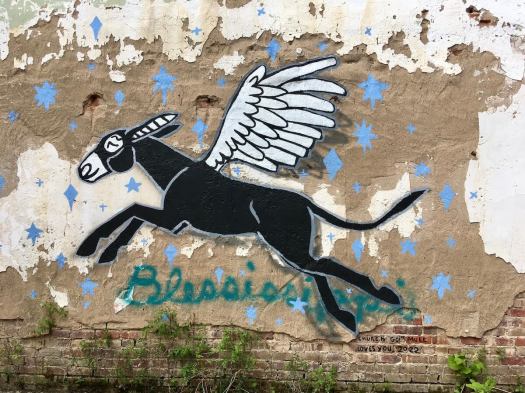
All the artwork is by Church Goin Mule and in Clarksdale, Mississippi, home of The Blues. I think that the ghost mule’s hind legs are partly obscuring ‘Blessissippi’.
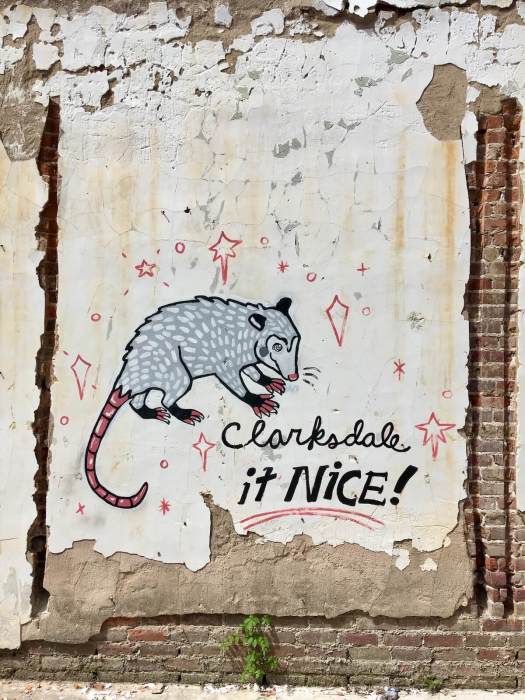
If you’ve heard how ‘it nice!’ sounds in the appropriate accent, you’ll need no help here beyond the reminder in the font. If you’ve missed out, when reading the words, smile. Heavily emphasise ‘Nice!’, load it with as much enthusiasm as you can muster and finish it off with a twist of surprise.
Possums may need an explanation too. They’re marsupials, and quite steady characters, despite their ability to feign death. And they’re easy to please. Unlike a picky diner, it’s easy to imagine them thinking, ‘it nice!’ about a slug, an over-ripe persimmon or a bit of a day-old boiled egg.
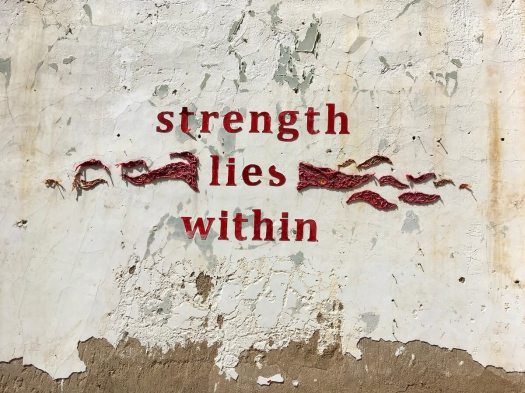
‘Strength lies within’ is underlined when the exterior surface is crumbling. The wave-like flourishes are made from woven material so stand just proud of the wall, ready to start their own peeling off.
This first trio is the selection I would more naturally share. Their story is upbeat and quirky. The colours and textures are alive, if muted. The visual ‘sound’ has been turned down; some of the interference is filtered out.
In the alternative series of images, a slightly wider crop turns up the visual interference. An equally affirmative message (‘Blest’) has been substituted for the message above. The story and mood are changed.
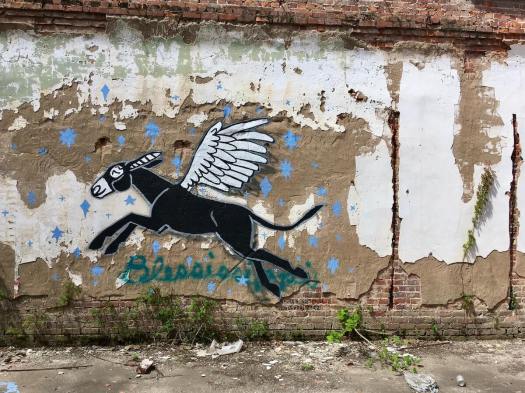
When we see more of the context, we may start to wonder if the artwork is on inside walls, not outside ones. We notice the plaster is crumbling to the paint-splashed floor and wonder how long it will be before the artwork joins it. With more going on, the message edges towards being a colour-carrying squiggle. We may note the decided direction of travel is from man-made to nature. How big will those vines and pavement weeds get?
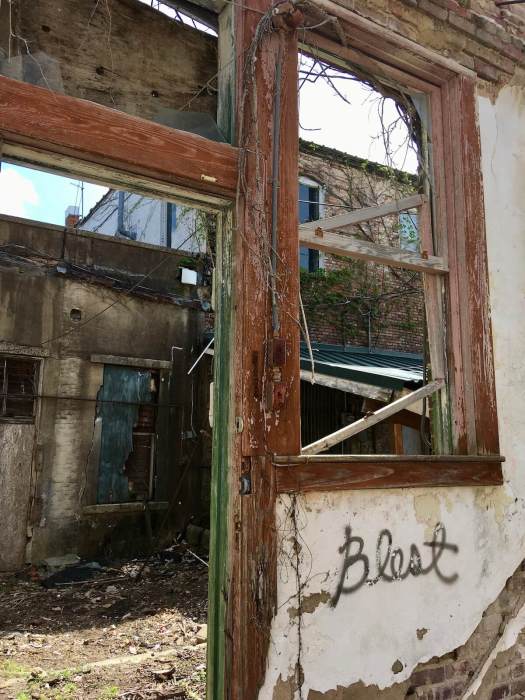
Does ‘Blest’ seem ironic in the context of a far from newly-derelict building complex a few hundred steps from a town centre? Artful neglect inspires a blend of respect and rapture in the music pilgrim, but may be less appealing if you are poor and you live or work among it.
Does it influence us that Clarksdale is built on the cultivated cool of neglect? Just as the patina of use raises the value of an age-worn antique, any attempt to clean or modernise risks lowering the value by making it more ordinary.
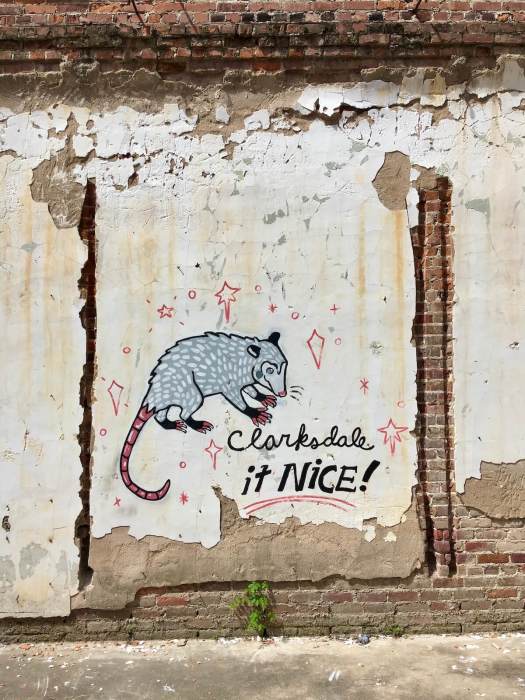
The artwork remains just as cheery, no matter the crop, wouldn’t you say? Happy within its context. The wall can and will crumble, but the artwork is there for now, and now is all there is.
Is one threesome of pictures more direct or honest than the other? Does hope need to turn a blind eye to inconvenient truths like loss, neglect or poverty if it is to soar?
I suspect the highest, most rare happiness is able to fully hold sadness within it.
In an article by Lucy Pearson published today, she asked Timo Auvinen to explain the secret behind Finland’s six years of world-leading happiness according to the Word Happiness Report. He replied, ‘Finns have several sayings about their quest for happiness. They include, “the pessimist will never be disappointed” and “happiness always ends in tears”, but also, “nothing is so bad that there’s nothing good in it”’. Their gist was that, as with the possum’s diet, lower expectations are easier met.
That’s as may be, but I’d rather see Mule’s folksy Southern Outsider Art affirmations painted on a wall than ‘happiness always ends in tears’, even if the building that provides a canvas is open to the skies and well on its way to earth.
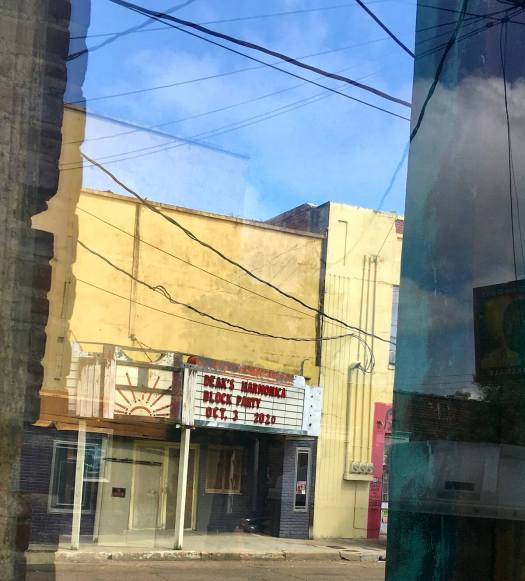
I’m ending with an arty shot. It was taken through a strangely intact window of the same derelict building looking out towards the Delta Cinema which is stylishly advertising an event from 30 months ago. I loved the colours, the lost-world, palimpsest effect of the reflections, the out of kilter crookedness, and all those tangled wires which I’d normally look to crop out.
Visit Church Goin Mule’s website for more of her creations. She describes herself as ‘Song-miner and story-shiner’. Her artworks often feature mules with legends such as ‘Don’t have to live big to live happy’. I found her quoted as saying, ‘I was thinking about my neighbor. How tall would he be if he was measured in stories? Most folks around here are twenty, thirty stories tall.’
Clarksdale is a great place for street art, much of it just ‘a little bit back from the main road’. To take your chance to reframe the artwork shown here, venture into the building/complex nearly opposite the Delta Cinema on 3rd Street, Clarksdale, MS.
Shared for the Lens-artists Challenge: Telling a Story.
 Susan Rushton
I love this! I had family in Cleveland, Shaw and Greenville in the Delta. Spent many wonderful hours and had many wonderful times there. This is great! Love the Church Goin Mule!
I’m glad to have brought back happy memories.
I love the possum but I think ‘It Nice’ really needs an apostophe ‘s’ to make more sense.
It would certainly need one for the Queen’s English (now the King’s English, but that will take some getting used to). It’s interesting how dialect speakers have their own grammar and apply it with perfect consistency. I remember my response on learning that (1) y’all could be singular and (2) to be fully inclusive, you’d need to say all y’all. I find myself liking (and using) dialect more and more, but it goes against all the teaching I had.
Clarksville doesn’t lack for interest, or poetry, but I can’t see myself making a beeline there any time soon, Susan. It’s all yours!
It would be quite a trek for you, especially as you have heart-tugs in the opposite direction.
🥺🩵
Great stories, great textures. And those Finn’s have a point, I think.
They must be doing something right.
I really like the juxtaposition of art with derelict buildings. If I were in the area, I would certainly take a look. My favorite is the donkey.
The mule, rather! I think you’d enjoy Clarksdale and I believe they have donuts.
Context is everything, and it always tweaks the story. Where does hope fit in? That’s the question, yes? Turning a blind eye hardly seems the way to hope, but then can we really see it all and still hope? Is turning down the “sound” fair? I loved “the palimpsest effect of the reflections,” the idea of measuring people in stories, and the stars around the possum. I checked Church Goin Mule. What a great name.
When we look at any image, our experience will affect how we read it; our character determines the quality and degree of any enjoyment, interest, emotion or approval raised. So while bloggers can offer pictures as some kind of shared moment, if we want to shape how their stories will be perceived we have to add a written narrative. It’s also fun to share an image without much of a guide and see what others make of it.
I absolutely agree: either way has its merits. Part of the challenge in writing is the unknown in the reader.
I’m willing to say “It NICE!” Is there any possibility that the possum’s a tribute to Fat Possum records in Oxford: the crew that started recording the northern hill country blues artists? It tickles me to think about the possum as bluesman, coming over to visit his delta friends.
I like that idea very much.
Great photos. Interesting textures!
Thanks, John.
This is profoundly thought provoking
It’s funny where artwork can take us.
Great finds Susan 🙂
It was one of those happy moments to find them.
I really like the juxtaposition of the art against the crumbling buildings. Striking! My favorite is the donkey. In Maine, we have all sorts of little sayings but as I’m sure you know, y’all isn’t one of them. But as someone who is smitten by words and language, I love regional differences.
Me too. Each of the little sayings has a kick of something in it – perhaps you’d call it spice or spirit.
Here in the south we too have y’all but not too often as most of the residents are actually relocated northerners like my husband and me LOL. Enjoyed your philosophical take on the challenge which made the artwork that much more interesting. Excellent storytelling.
Although, as there were more questions than answers, perhaps the storytelling is actually in the mind of the reader.