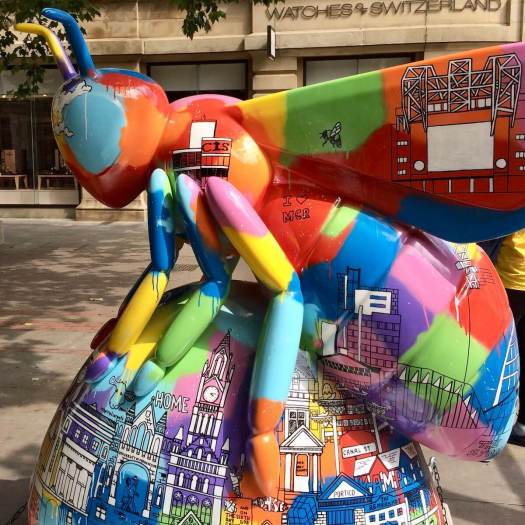
Denzil has invited us to share bees ‘of any species, size, sex, colour and activity’. Despite the broadness of the brief, I’m not sure he’ll have been expecting these.
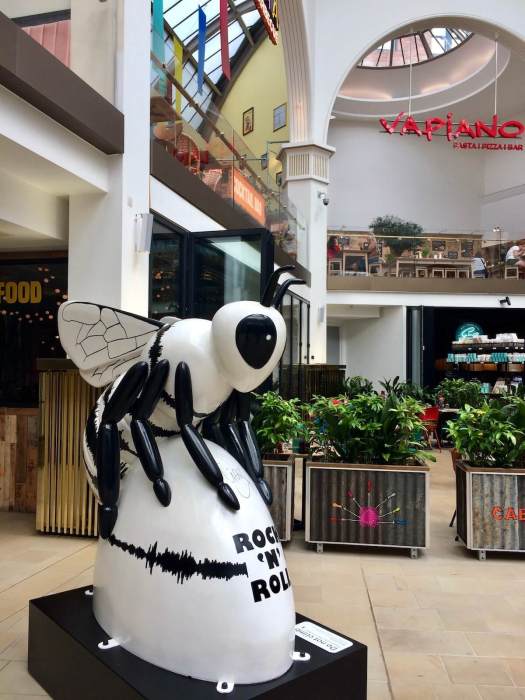
Bee in the City was a free art trail, scattered with terrible puns, held in Manchester, UK several years ago. Artists decorated a standard 3D blank in their signature style, often working in association with charities or local businesses as sponsors.
I’ve seen similar events in Liverpool and Boston. The trails are memorable, family-friendly, brighten up their host cities, help highlight local causes and stories, and lure people away from following their standard routes.


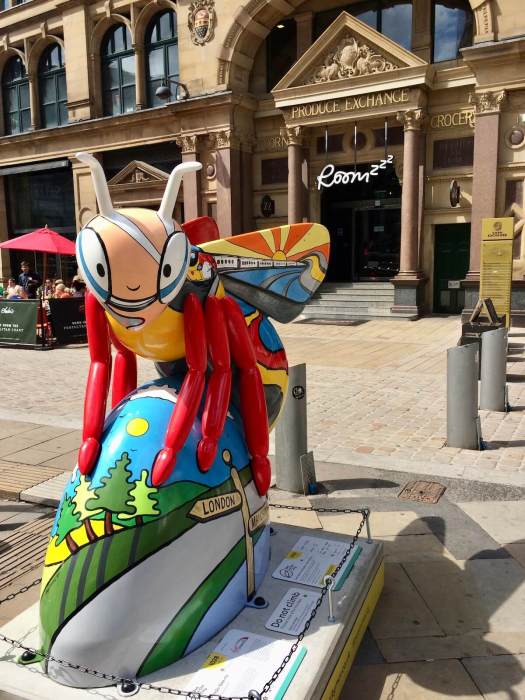
I’ve restricted myself to just a few so not to try your patience and am signing off with a couple of ‘real’ bees.

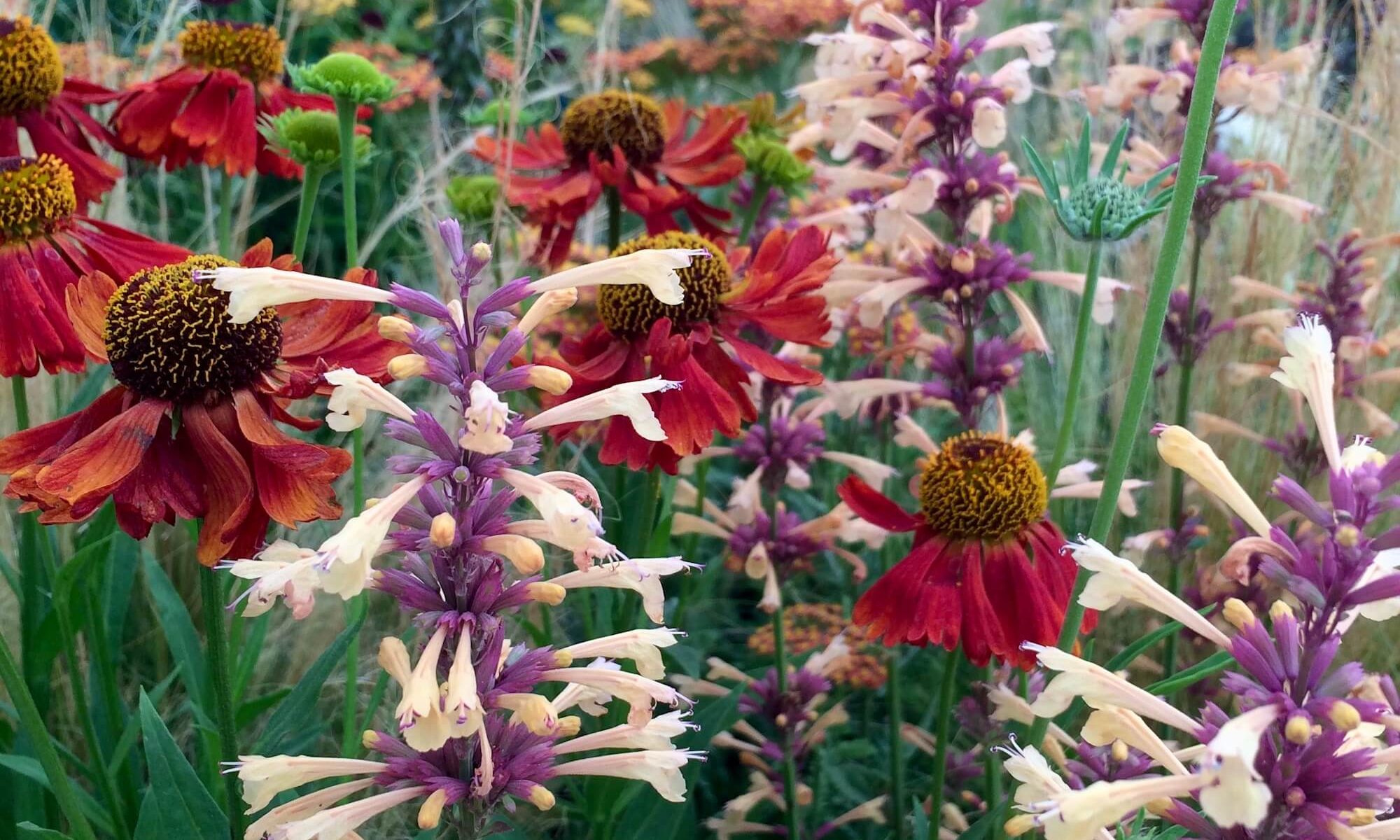
Imagine this bee intently swaying on the flower spikes of my favourite basil. Try growing African Blue if you can get your hands on some. It can be perennial if sheltered inside over the winter and is well worth growing for the flowers, even if you don’t use it as a herb.

We went to a talk on bees and other pollinators last week, and the lecturer set out to dispel some of the conventional ideas we have about bees. He was particularly scathing about most commercially available bee hotels – bee cemeteries, as he calls them – suggesting that anyone who wants to help bees would be better off planting flowers.
Shared for the Nature Photo Challenge: Bees.
 Susan Rushton
Ha, no I didn’t expect these kinds of bees Susan, but very welcome! Was interested to read the bee expert’s opinion of bee hotels: did he explain why they are “cemeteries”?
In general he felt they were poorly researched. The bees often die because the hives can’t be cleaned or when predators are attracted. He pointed out that some materials are the wrong dimensions for bees. Some bees need to seal the hole after laying eggs, and if it’s too wide it would take them ages.
Right, I see now. Yes I suppose it’s like bird nestboxes, some of the commercial ones available look beautiful, but are not practical. I get my bee hotels from renowned nature supplies centres and they seem very popular with the bees.
🤗 Fabulous bees. I’m glad you have had the opportunity to share these with us. The only bee hotel I fancy is one where you can actually see the workings of the bees. I wonder if that one would pass the test?
He had designed a hive that you could see inside, although I’m not sure whether the bees would be too happy about being seen but wasn’t selling them at the moment. The main issues were being able to keep them clean and not attracting predators, as Eliza mentioned.
Very creative: fun, and also attractive. One of our nearby cities has done the same with pelicans, and yet another adopted the idea and began spreading artistically decorated herons around the community. In these two cases, the installations are permanent; some towns do the same, but the pigs/cows/chickens/whatevers disappear after a time.
Liverpool claims to have had the earliest trail, although I don’t know if that’s true. Theirs were superlambananas – a cross between a lamb and a banana. There are still some around.
I always enjoy this sort of trail – we’re expecting Morph in London later this summer! Am I right in thinking that bees became associated with Manchester after the arena bomb attack?
As for your real bees, the one on the dahlia is especially striking. And interesting info about those bee hotels – thank you 🙂
Manchester has had the worker bee as a symbol since the industrial revolution, but you’re right that they have worn and displayed it proudly to help show resilience after the attack. The Morphs should be fun!
I’ve seen them all myself, it’s great to have some together in a post. They certainly count.
– Esme buzzin’ upon the Cloud
Love the decorated bees! (The city near us had cows – but what else would there be for a city that is called ‘Cow Town’ during the Stampede!)
I totally agree with the advice to just plant flowers and leave the bees to figure out their own housing.
I have seen cows in Zurich, I think, now you mention it.
You had a great series of photos here. I love the creativity of the art bees.
Anything that brightens our cities works for me.
You have a nice selection of fanciful and real bees here!
Victoria BC had a similar project years ago called Orcas in the City, resulting in killer whale statues in various colours and patterns.
I’d have loved to have seen the orcas. I hope they were very big!
They were 8 feet long, and imaginatively painted. No wonder I remember them from 2004!
Here’s an example: https://www.flickr.com/photos/hernandezfisher/1397924/