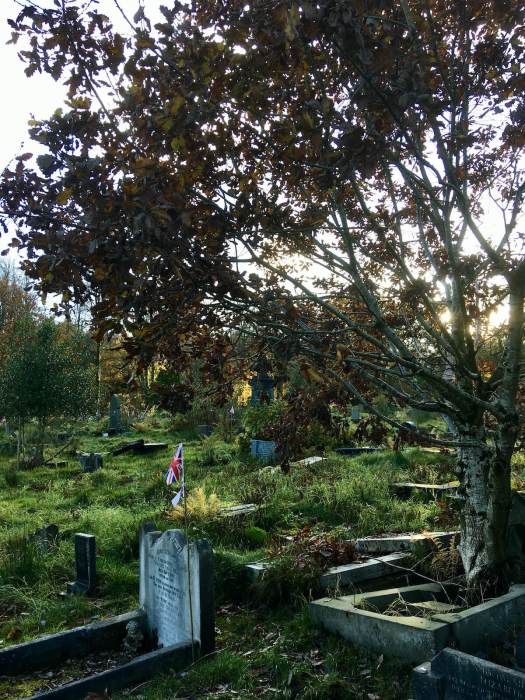
For The Fallen, a poem by Laurence Binyon, written for an English audience towards the start of the 1914-18 war, has since been adopted as a tribute to all casualties of war. This scene in Darwen’s old cemetery yesterday embodies the idea
At the going down of the sun and in the morning
We will remember them.
Darwen’s old cemetery is part wild and atmospheric, part lovingly tended, and overlooks the town from a hillside. I spent some time yesterday randomly visiting graves in the older part. I’m not sure how I was drawn there as I had planned to go up to the edge of the moor, but it seemed right.

Volunteers were working in the cemetery tidying up overgrown vegetation. Flags had been placed to mark the 97 war graves and fresh bark paths had been laid to some of the higher ones. Schools and organisations had left tributes along a memorial wall that explains the events of the war from the town’s perspective, making clear the scale of the suffering involved.

One panel on the wall, The Peace, describes what happened on and after the armistice was signed:
Darwen received confirmation of the armistice shortly after 11am which was announced by the sounding of a long blast on the fire siren and the loud ringing of the church bells. Flags and bunting appeared from nowhere… The joy of the peace was mixed with sadness for the lives lost.
…From this came the war memorial situated in Bold Venture Park which was unveiled on 24th September, 1921 by Mrs Chadwick, a mother who lost three sons in the war.

It’s chilling to remember, but we forget at our peril when so many contemporary voices are sowing division, resentment, fear and worse.

So I was happy to see so many poppies in the cemetery and adjoining Whitehall Park, many drawn by local children or made from recycled plastic and bits of wire.


When we visit the war graves, often of single men with their own neat headstone set alone or on the edge of family graves, we are in the presence of absence, reminded of generations who were not born because someone was killed.
If we owe fallen soldiers a personal duty, it is to remember that peace is fragile: that this war to end all wars didn’t.
 Susan Rushton
Beautifully expressed, both words and images.
Thanks, Laurie.
Thank you for this, so eloquent in image and text. You have expressed the inexpressible. “In the presence of absence” indeed. We owe them our best efforts towards peace, and, as you rightly point out, especially in such a time as today’s. The war memorial in the snow is particularly poignant, more so with the knowledge that it was unveiled by a mother with such grief.
The angel memorial has always had a stern presence even if you don’t know anything of its story, and even though it holds an olive branch.
You have given us the essence of the occasion in such a beautiful way.
Thanks, Anne. I’m glad.
Lovely photos, Susan.
Thanks, Timothy.
We owe them a great debt of gratitude. Sadly, here observances seem to be fading away, a dangerous trend of forgetting where the lesson is lost.
Forgetting seems the easier option when the lessons learned are so harsh. We need a way to remember with hope and honesty – and fewer world leaders looking to gain votes by posturing like robins.
Lovely photos Susan – and your last six words, so poignant and so very true.
Tragically.
The poppies in the cemetery and adjoining park, seem very informal (in a nice way) -A great post as we all remember those fallen.
It’s heart warming that children are making them over 100 years later.
You have shown to us another facet of visiting a cemetery. Yes, they might be physically gone, but they are not forgotten. Lovely memoirs you find as well, the Poppies are wonderfully made.
My sweetheart is interested in seeing what flowers grow in cemeteries, so I have spent more time in them than most.
Indeed. I was near you today, in Bury, where my grandson,an Air Cadet, was one of the flag bearers. We commented that Remembrance Day has once again assumed some national importance, attracting a largish crowd. I remember when I was younger, it was little regarded, and there were calls for its abolition. Let’s hope this is accompanied by a degree of thoughtfulness about war and its consequences.
I can’t believe we still have so many old, romanticised war films on British TV.
Thanks for sharing. So many lives lost in war, even today.
And so many uprooted fleeing from it.
Three sons lost! How would you ever go forward from there? It makes me ashamed of the fuss I make over distance.
Distance between loved ones is a weary thing, Jo. I was unsure about quoting this as it is such a terrible thing to read – but how much easier to read than to live.
We hardly have any conception of suffering, Susan 🙄💕
A wonderful post. And how apt to mention Lawrence Binyon as he too was a Lancastrian. My favourite Binyon poem is The Burning of Leaves.
I don’t know that one but will check it out.