The Isle of Man seems to live in more than one dimension of time: history and mythology naturally co-exist with everyday life. This is an island, you may remember, protected from its enemies by a magical mist where bus announcements reference the local fairies.
Cregneash living croft is one of many sites that raise awareness of their proudly independent national heritage. It’s home for some of the island’s special breeds of animals, such as tailless Manx cats.
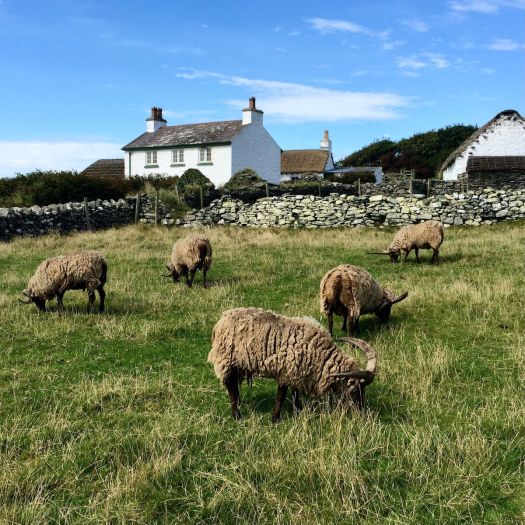
At first glance, visitors might overlook the small, hardy, naturally short-tailed Manx Loaghtan sheep farmed there.

Until they raise their heads, that is, and those heavy horns are on display. While four horns are the norm, some Loaghtans have two or six. Loaghtan is an adaption of the Manx lugh dhoan (mouse brown) in celebration of their soft, hard-wearing, brown wool. The upper layers lighten in the sun, but near their bodies it is darker, like their legs and faces.

I recently read Tamed: Ten Species That Changed Our World by Alice Roberts. She points out that in our dealings with plants and animals, as in so many aspects of life, our goal is efficiency. We chase the fastest way to more.
We’ve narrowly focused on a few varieties of fruit, animals and birds, selecting the most amenable to satisfying our needs, then have multiplied them to millions or billions. It’s a dangerous way to go.

We’re belatedly starting to realise that diversity is not just a feel-good catchphrase. Some farmers cottoned on early and have been determined to keep our rare breeds of pigs, sheep, cattle, poultry and horses going, despite the pressure mass farming brings.
While the small, long-legged Loaghtans lived on the Isle of Man’s misty uplands for a thousand years, at one point in the 1950s only 43 survived. Since then, enthusiasts have increased their numbers until they are merely ‘at risk’, with around 1,500 breeding females.
You can find out more about the work of the Rare Breeds Survival Trust here. Even if you have no interest in conservation, there are some animals that will raise a smile, such as sheep with ears like rabbits or coats like Dougal from The Magic Roundabout or with names like Whitefaced Woodland, Castlemilk Moorit and Lonk.

But the trust is unable to report all good news. Some of our most magnificent and iconic horses are in danger. A post explains that ‘just 240 Shire, 199 Clydesdale and 25 Suffolk pedigree foals were registered last year’, which seems to have been 2017.
I try to educate myself about the way we are heading, but that shocked me. I thought back to the few times I’ve been in the gentle presence of a shire horse, marvelling at its high, nodding head and the feathering on its feet – fleeting moments that thrill and calm at the same time.
Four years on, are we headed in the right direction, I wonder?
Shared for PastSquares
 Susan Rushton
somewhere I’ve always wanted to go, and now even more so seeing these fantastic breeds
I felt sure you’d approve of this one!
😊
Great post. I love sheep of all their splendid varieties.
You’ve reminded me of a magazine editor who liked to have at least one sheep in every issue.
I love your post!!
Joanna
Thanks, Joanna.
They are a good looking flock.
The curl of their horns gives them a lugubrious look.
Never seen them before, thanks for sharing and the info you gave us about this special race.
My pleasure!
What a thoughtful, and thought provoking, post, Susan. I spent a few days on the island a lot of years ago. Sadly I didn’t see these guys. Maybe that’s why some of them look so sad?
Either that, or carrying those hefty horns around.
Your photos are beautiful, your message sorrowful. We need to hear it, though. What magnificent beings we may yet lose.
I’ve been reading of some of the larger and stranger sounding animals we have lost only relatively recently. Part of the trouble with humans is that we think in such small timescales.
True and scary.
Oh, sounds like my kind of place! On a a sadder note…those horses. Sigh. You end with a somber but relevant question.
You would like the Isle of Man, I’m sure.
Me, too!
Thanks for writing, this was so fascinating and the images are fantastic 🐐🐑 😍
My pleasure – I’m glad you liked it.
Very interesting post and great pictures of these beautiful sheep, Susan. The lack of diversity on our farming and that narrow focus you speak of comes at a price, and I doubt we have any idea how steep.
I agree with you.
Those sheep are quite spectacular! I’m glad some are saving the rare breeds, as so many have been lost in the past century. Efficiency may be our downfall.
If nature was ruled by efficiency – actually, that’s a thought I can’t pursue. I don’t think we’d be around, at any rate.
Very interesting and beautiful sheep!
Thanks, Amy.